
Aleksandra Mir, Whitney Museum of American Art
Artforum
New York, February 2012
“Rather than mocking or privileging one system of thought over the other, the collages merely posit different methods of ascension, one physical, one metaphysical”
By Emily Hall
Aleksandra Mir's video The Seduction of Galileo Galilei, 2011, is based on Galileo's fabled experiment with falling bodies. The physicist is said to have dropped objects of different weights from the top of Pisa's famous leaning tower in 1598, in order to demonstrate that they would accelerate at the same speed regardless mass. In Mir's version, the tower itself is the object of experimentation: A group of volunteers piles car tires on top of one another until the stack gives in to gravity and crashes to the ground.
The video - on view at the Whitney Museum of American Art in a presentation organized by Carter E. Foster - has a disarming charm, and a heaviness that is worn lightly. It begins with shots of a crane and a cherry picker arriving at the go-cart track where the experiment is to be staged, followed by a brisk montage of still images that show a group of adolescent onlookers gathering, volunteers preparing the winch and crane, and caution tape being strung between chairs. Then the stacking begins: The first ten or so tires are laid down by hand, with volunteers taking turns carrying, rolling, hoisting, and patting them into place; the mood at this point is light and playful, as if the project were a game. As the tower grows higher, things become more serious. A volunteer in a lift corrals the tire, which dangle from the crane, and lowers them rather solemnly onto the growing stack.
The Seduction of Galileo Galilei is shown with a handful of works from The Dream and The Promise, 2009, a series of collages that juxtapose devotional images of Jesus Christ and the Madonna with illustrations of satellites, rockets, and photographs of the universe: halos become planets and satellites become implements of martyrdom. But rather than mocking or privileging one system of thought over the other, the collages merely posit different methods of ascension, one physical, one metaphysical.
The video, too, invites us to contemplate the parallel trajectories of science and faith, partly through flickers of religious iconography: the crane and cherry pockier arrive in solemn procession, like bishops during Holy Week; the artist and a crane operator greet each other in an echo of God's creation of Adam on the Sistine Chapel ceiling; and, in one slow motion shot, a man raises his arms in a helpless gesture that is frankly cruciform. Even the logo on the heavy machinery is drawn into Mir's symbolic system. Although the trucks provide help that – quite literally – comes from above, the company name, Modern, emblazoned on the machinery, bring things down to earth. These moments seem more spontaneous than staged, noticed by Mir and foregrounded in the film thanks to her careful observation of the event.
In the end, the experiment is finally resolved when the tires are chained together and then lifted into the sky in a long, twisting tube before being allowed to drop, awkwardly coiled, in an uncommonly joyful moment. What comes into focus is a sense of ludic collaboration – of strangers coming together – rather than scientific rigor or the pursuit of success. In this sense – as well in its use of tires – Mir's video recalls Allan Kaprow's Yard. When he first executed the work in 1961, Kaprow filled a courtyard with tires and encouraged viewers to play. In this and other works' he called Activities, he encouraged spontaneity, viewer anticipation, and restating by other artists; in fact, he let the works' meaning be constructed from these elements, from mess and happenstance, rather than according to his own direction. Here such spontaneity leads to an interlude in which volunteers make stacks of doughnuts and coffee creamers. The playfulness and, somehow, perfect rightness of this moment suggests that Mir, too, enjoys the invention that cab result from the loss of control. "you have to allow for a good deal of chance," she has said of her working process, "and count on the grace of others." In other words, one must have a kind of faith.

Build Your Collection
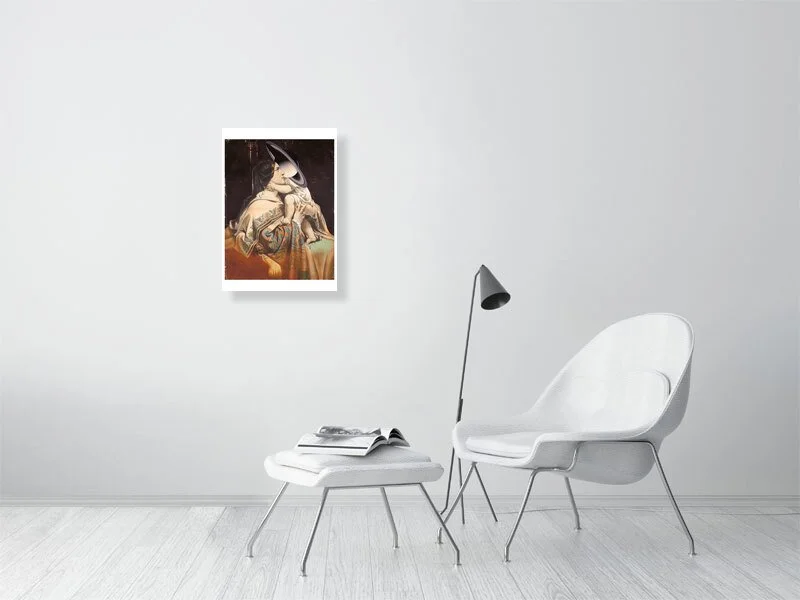
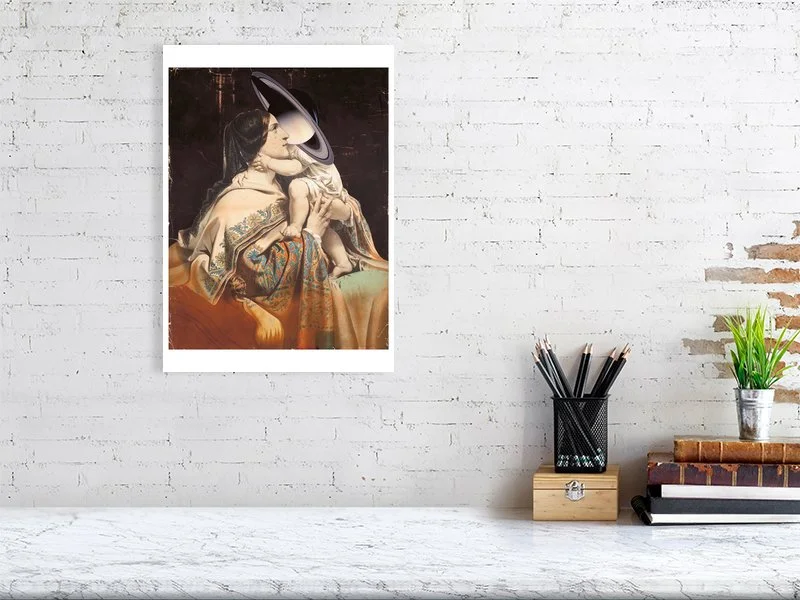
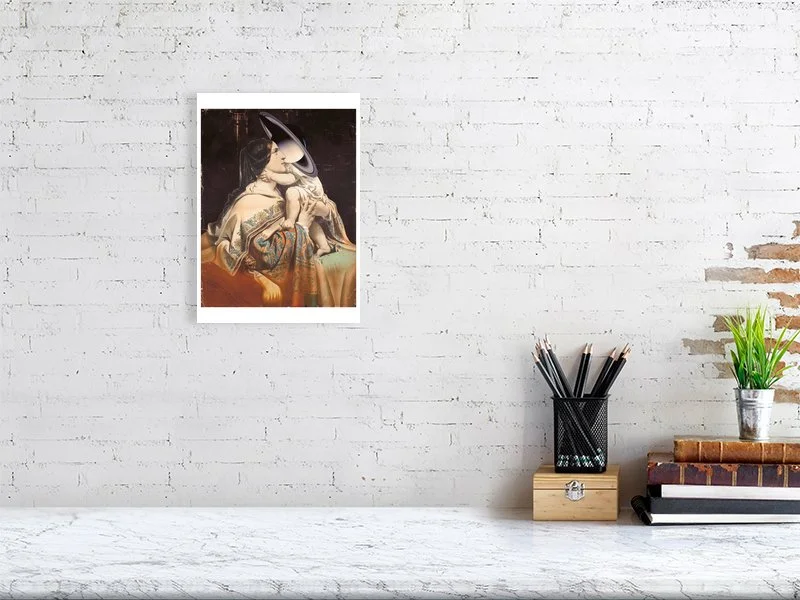
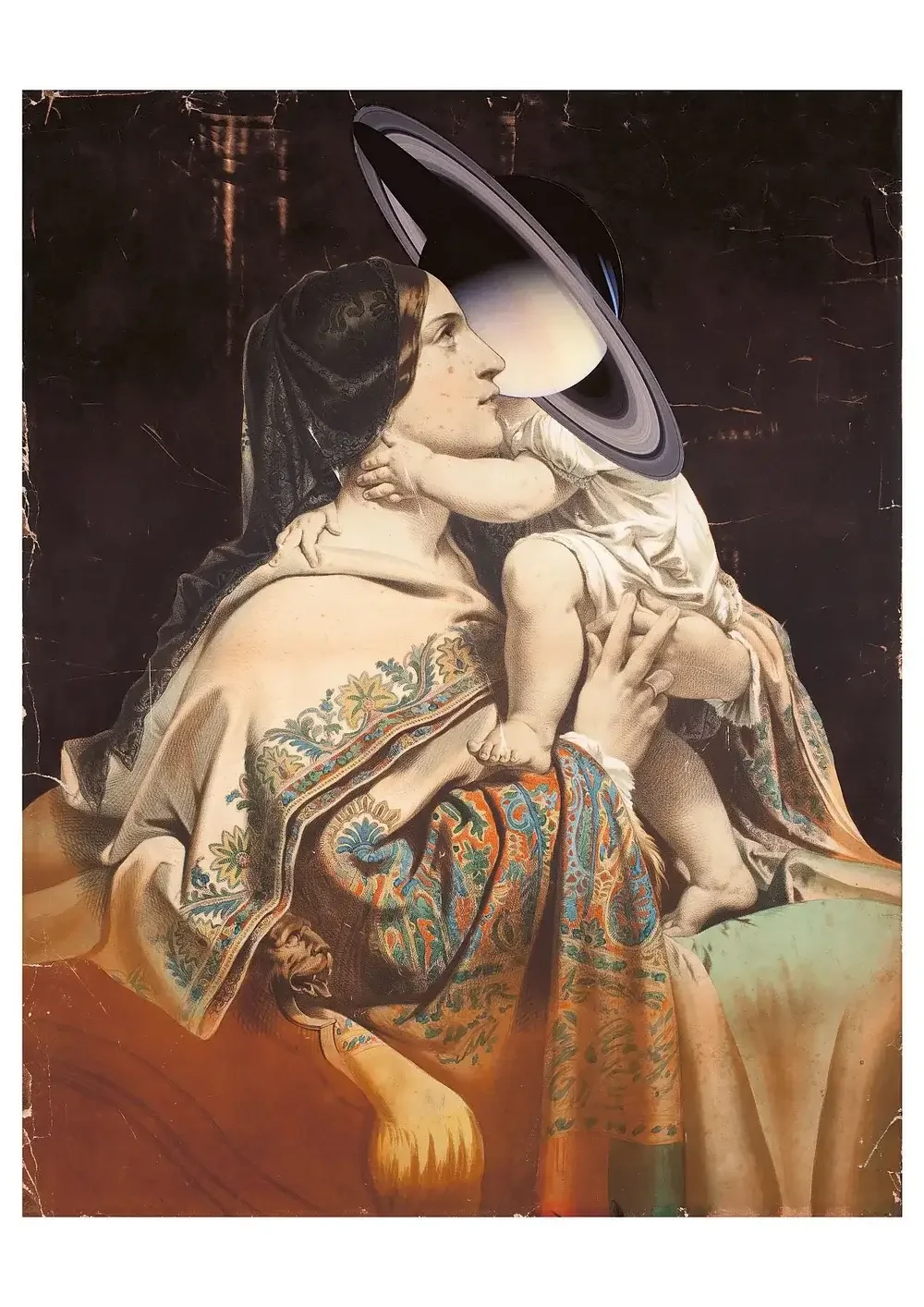
The Madonna dressed in richly coloured robes is holding her Child with the face of the planet Saturn. This tender Fine Art Print reproduces an original hand-cut paper collage by the artist Aleksandra Mir.
The restraint of the intervention — one perfectly placed astronomical image doing all the work — shows a very assured artistic hand. The halos that would traditionally crown both mother and child in a Madonna and Child composition have been replaced with a single image of Saturn and its rings, positioned so the planet rings encircle both their heads simultaneously like a shared crown.
The new artwork combines source materials from antique religious and modern scientific imagery into a new physical and fantastical reality that is deeply moving. The rings of Saturn — one of the most awe-inspiring sights in astronomy — become an emblem of the bond between mother and child. The infinite and the intimate held in the same frame. The worn, cracked paper grounds it in time and mortality, while Saturn speaks of cosmic permanence.
Giclée pigment ink on Hahnemühle German Etching paper achieves a superior quality print with exceptional detail, vibrant color accuracy, and long-term durability. The fresh print reproduces an aged authentic patina and the imprint of the artist’s hand-crafted marks.
· Archival Museum Quality ·
· Limited Edition. 100 ·
· Certificate of Authenticity ·
· Hand & Human-Made without AI ·
· 100% Carbon Neutral ·
· Free Worldwide Shipping ·
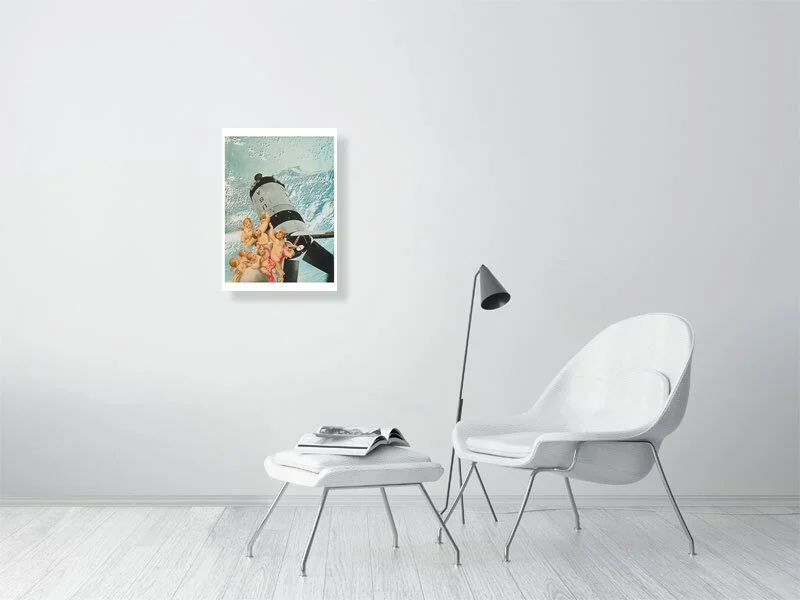
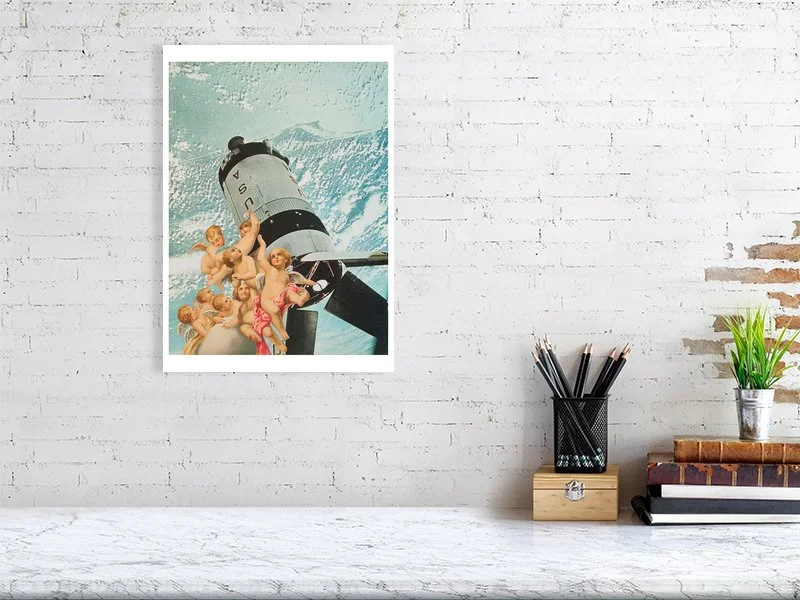
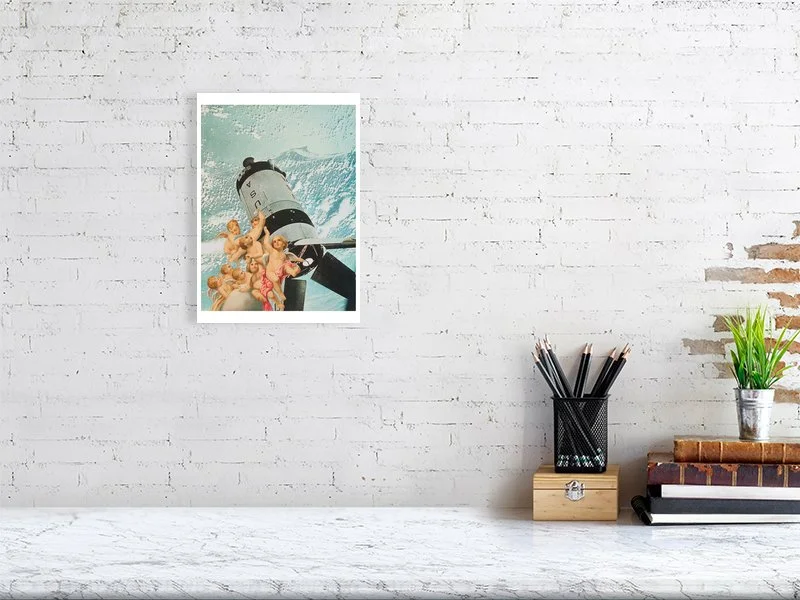
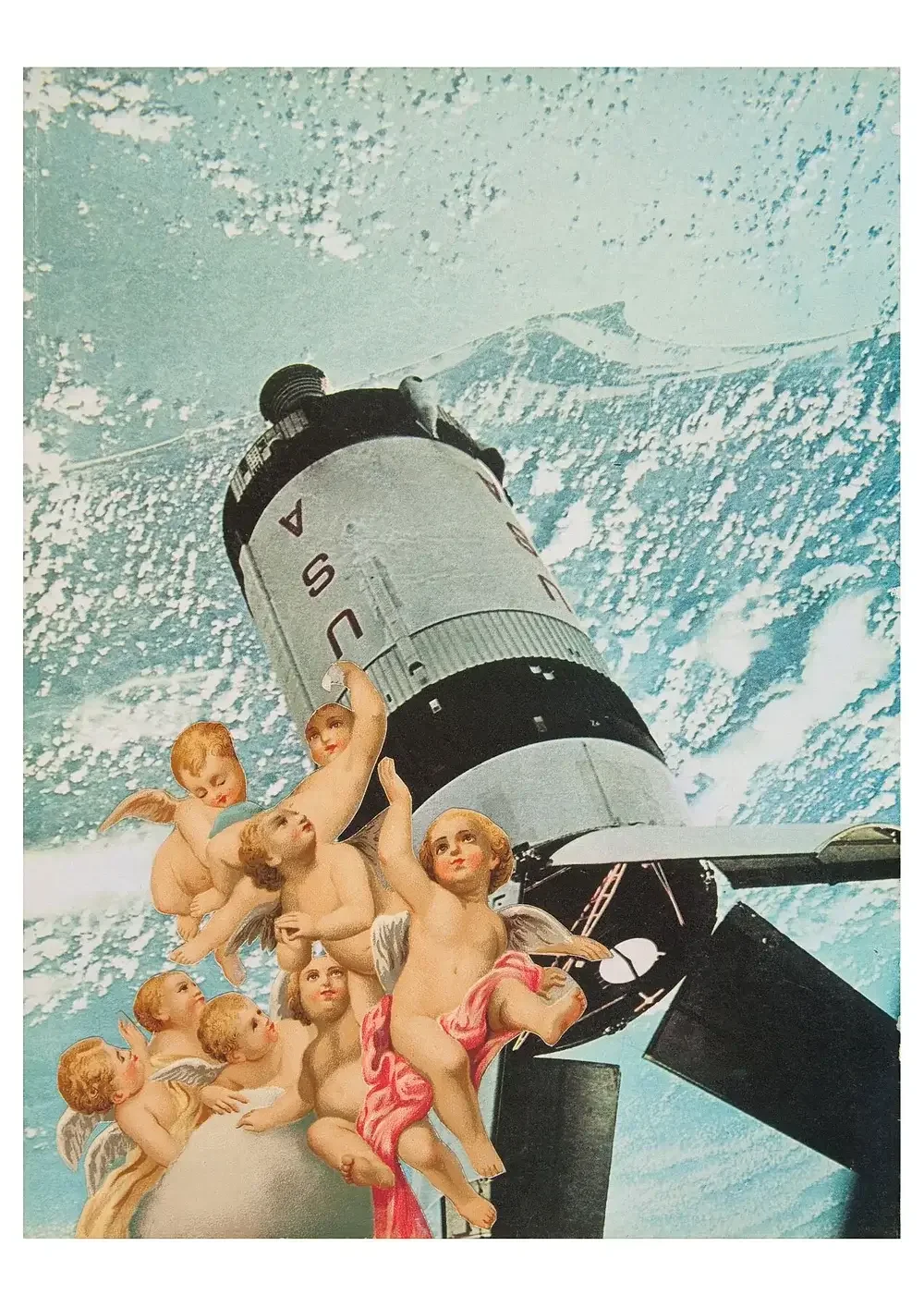
A cluster of cherubs — putti, the chubby winged angels drawn from Renaissance and Baroque painting — surround an outer space rocket. Together they are launched into the blue heavens or perhaps all the way to outer space. This joyful Fine Art Print reproduces an original hand-cut paper collage by the artist Aleksandra Mir.
The new artwork combines source materials from antique religious and modern scientific imagery into a new physical and fantastical reality.
The cherubs, traditionally symbols of the divine and heavenly aspiration, have transferred their devotion from the sacred to the technological. The rocket becomes the new object of veneration — humanity's collective dream made metal. The old world meets the new in an incongruous but tender embrace.
Giclée pigment ink on Hahnemühle German Etching paper achieves a superior quality print with exceptional detail, vibrant color accuracy, and long-term durability. The fresh print reproduces an aged authentic patina and the imprint of the artist’s hand-crafted marks.
· Archival Museum Quality ·
· Limited Edition. 100 ·
· Certificate of Authenticity ·
· Hand & Human-Made without AI ·
· 100% Carbon Neutral ·
· Free Worldwide Shipping ·
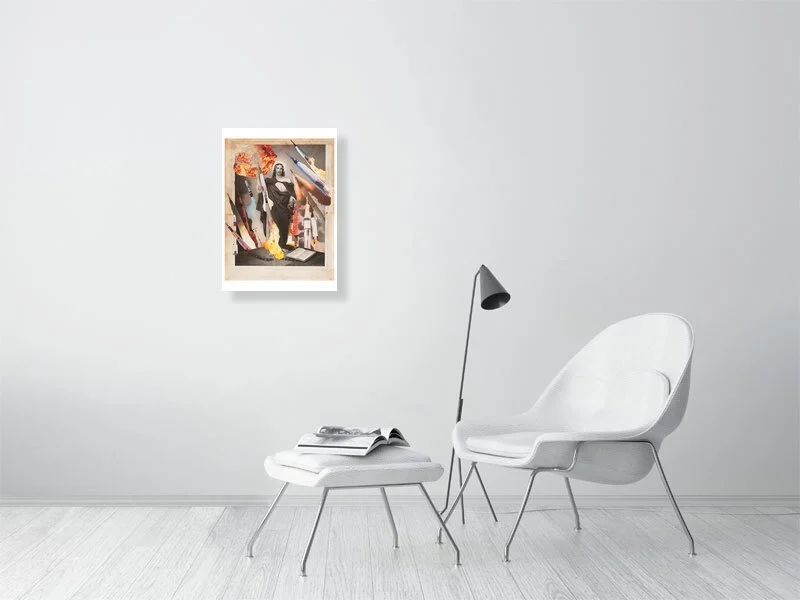
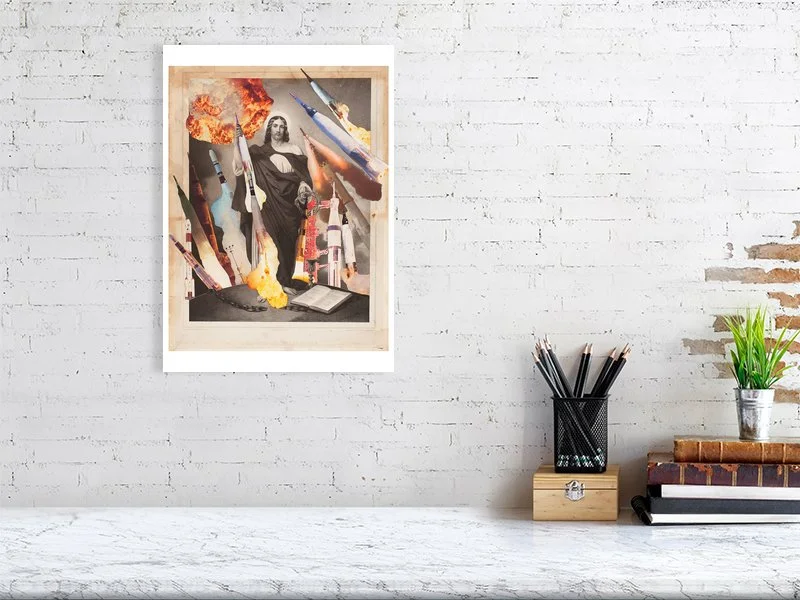
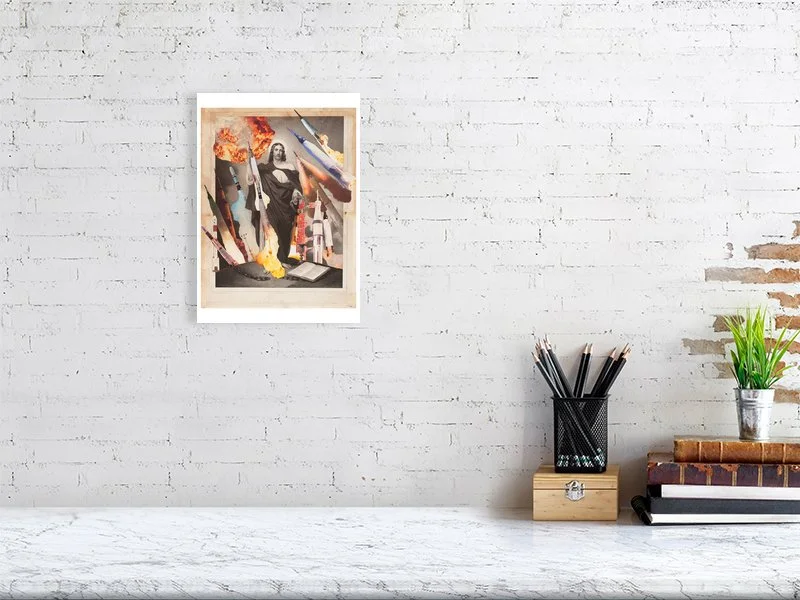
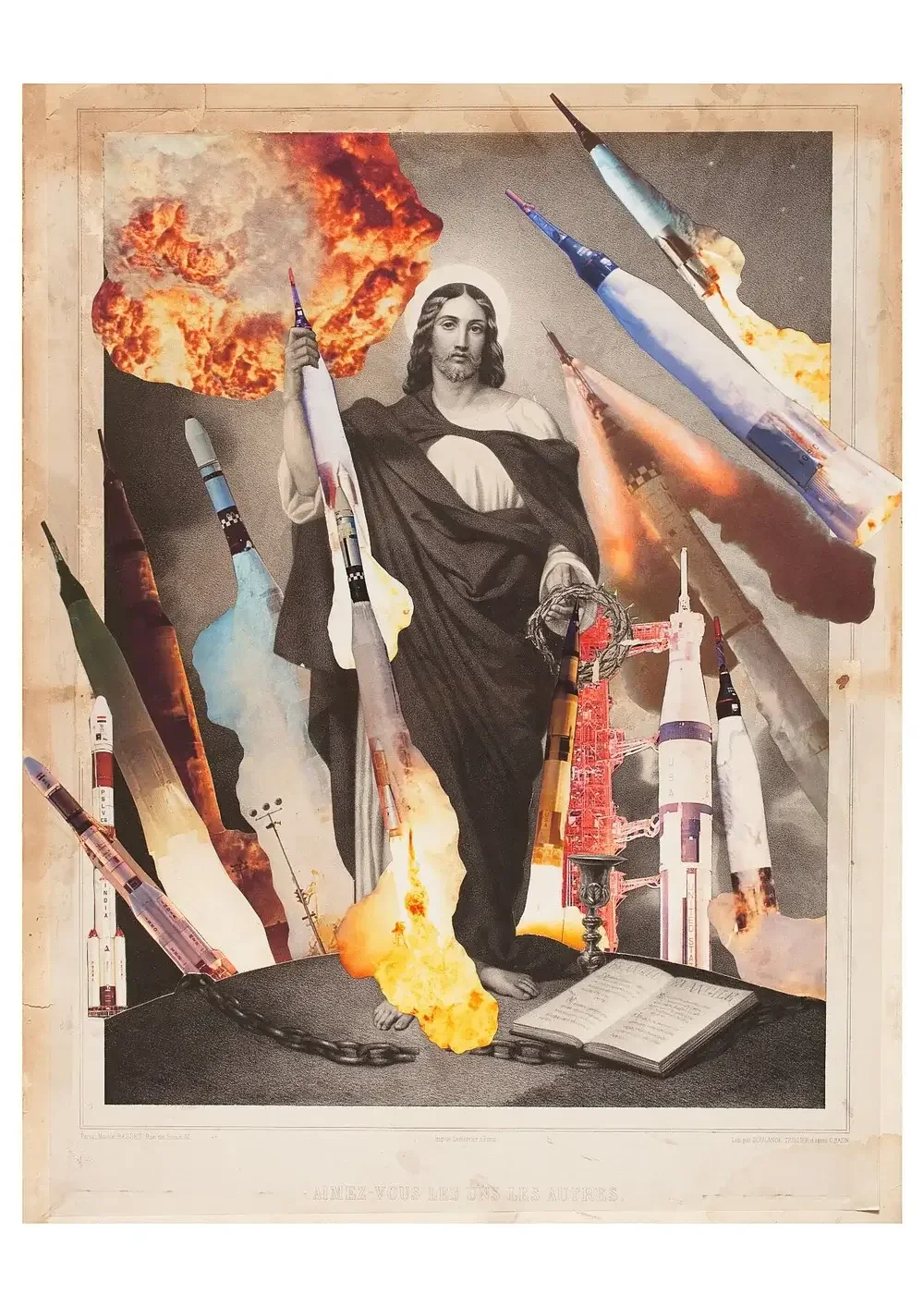
Jesus Christ surrounded by a spectacular burst of rockets radiating outward like a halo of human striving — a Fine Art Print of an original hand-cut paper collage by Aleksandra Mir.
The new artwork combines source materials from antique religious and modern scientific imagery into a new fantastical reality. The source is a large format 19th century French devotional lithograph with the text AIMEZ-VOUS LES UNS LES AUTRES (Love one another).
Into this devotional image Aleksandra Mir has collaged an explosion of rockets — many different types from different eras and nations, recognisably including Saturn among them Saturn V, Indian PSLV, and various missiles — launching, soaring, and careening through clouds of fire and exhaust. Christ holds a rocket in one raised hand, imbuing the artwork with extraordinary compositional energy.
Giclée pigment ink on Hahnemühle German Etching paper achieves a superior quality print with exceptional detail, vibrant color accuracy, and long-term durability. The fresh print reproduces an aged authentic patina and the imprint of the artist’s hand-crafted marks.
· Archival Museum Quality ·
· Limited Edition. 100 ·
· Certificate of Authenticity ·
· Hand & Human-Made without AI ·
· 100% Carbon Neutral ·
· Free Worldwide Shipping ·
Frequently Asked Questions
-
Aleksandra Prints are museum-quality reproductions of original hand-cut antique paper collages by artist Aleksandra Mir, created in her Palermo, Sicily studio in 2007–2009 and exhibited internationally for two decades.
Aleksandra Prints started on the initiative of an audience member who discovered the original artworks in an exhibition and asked for affordable reproductions.
What is a collage?
A collage combines elements from different sources into a new image and physical reality.
The materials for these collages were sourced from antique dealers and second-hand bookshops. As such, the fresh print reproduces a patina with authentic wear and tear.
Furthermore, in creating the collages, the artist sliced and tore through the source materials leaving the imprint of her hand-crafted marks.100% human-made. No AI was used in the creation of these artworks.
-
Giclée print on Hahnemühle German Etching paper
Giclée (pronounced "g-clay") comes from the French gicler — "to spray." The process uses high-resolution inkjet printing, pigment-based inks and acid free papers to deliver a superior quality print with exceptional detail, vibrant colour accuracy, and lasting durability.
Hahnemühle German Etching is a traditional mould-made copperplate paper. Crafted from 100% alpha cellulose, it has a distinctively velvety feel and fine felt texture that brings images to life with a striking three-dimensional depth. Acid- and lignin-free, it meets the highest standards of age resistance.
-
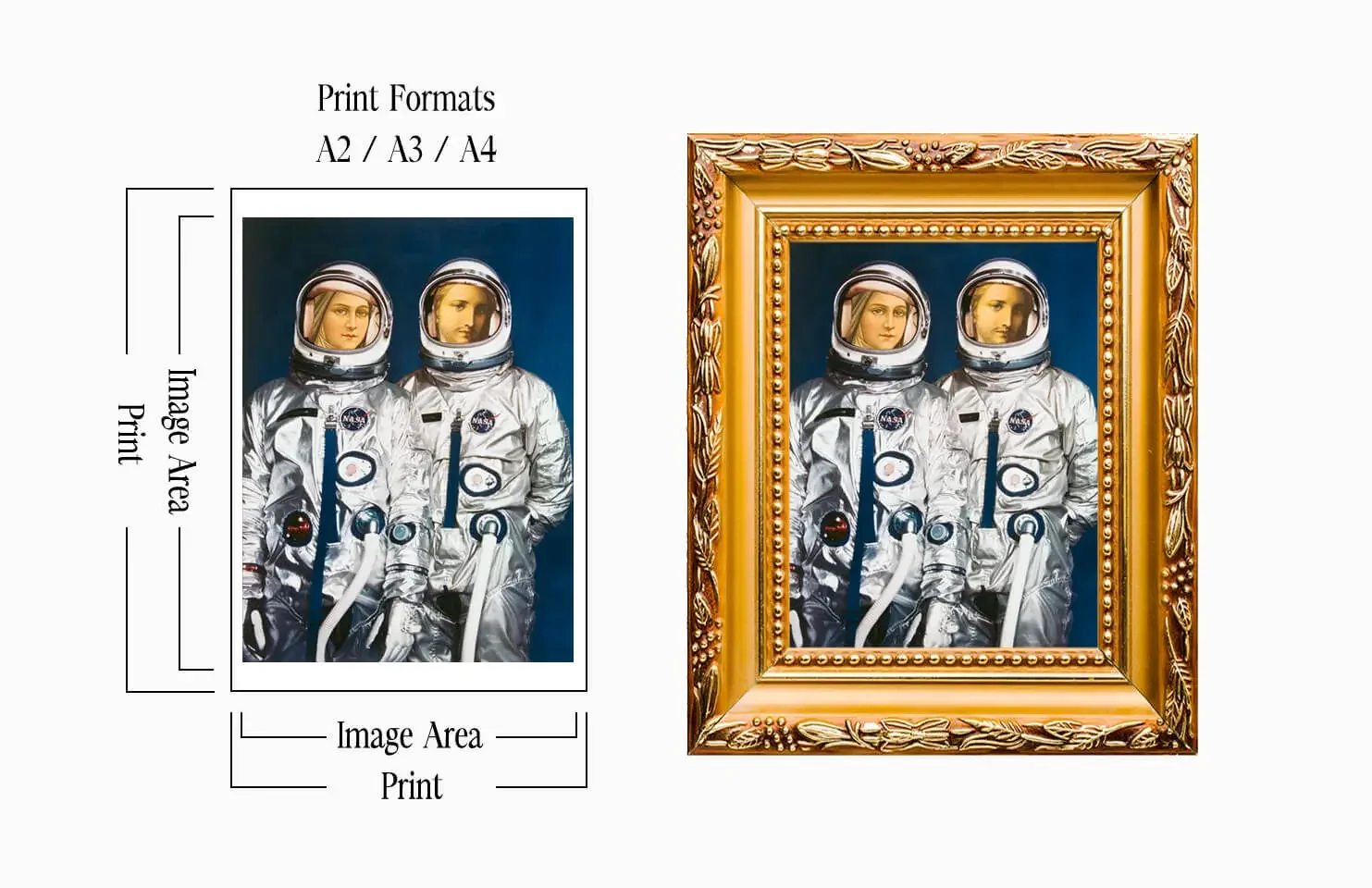
Aleksandra Prints come in three standard formats, Small, Medium and Large:
A4 (S) – 21 x 30cm / 8.3 x 11.7"
A3 (M) – 30 x 42cm / 11.7 x 16.5"
A2 (L) – 42 x 59cm / 16.5 x 23.4"Please note that each original collage was created in a unique format and the image areas within the prints therefore slightly vary. The image areas are surrounded by white space to create the uniform print formats: A2, A3 or A4.
You can keep the white space, extend it with a mat or crop it out when framing.
-
Aleksandra Prints are only available from this website, www.aleksandraprints.com
Each print comes with a signed and numbered Certificate of Authenticity that holds a 3D embossing.
We are able to confirm the first sale provenance of every print.
-
Aleksandra Prints does not offer framing because shipping artwork behind glass is both risky and expensive. It is much better to have your print framed closer to home.
We recommend these three style options:
Minimalist – A ‘frameless’ clip frame in glass or acrylic in standard A4, A3 or A2 formats that match the prints sizes exactly. These type of frames are easily available in shops and can be ordered online.
Mediumalist – Adding a larger white or colored mat to extend the white space around the image area up to any preferred size. This framing method protects the print by allowing some air between print and glass. Select any custom-sized frame and profile from a framer of your choice.
Maximalist - New or antique Gold, Bronze or Silver custom made frames with a different profile for each print. Visit a local framer to explore their profiles or source frames from markets and antique shops.
-
Aleksandra Prints offers FREE shipping worldwide.
Our prints are produced in and shipped from the United Kingdom by Royal Mail.
Production & Delivery:
(UK) 7 days
(EU/USA) 14 days
(Rest of the World) Pending Location.
Tracking: All orders are dispatched within 48 hours. As soon as a print is shipped you will receive an email with tracking details for your order.Customs Fees & Taxes:
UK orders: No VAT.
USA orders: No sales tax or tariffs.EU orders may be subject to local import VAT and a small customs handling fee payable on delivery. These charges are set by your country’s customs/courier and are not collected by us. The commodity code 4911 91 00 refers to pictures under the category of printed matter with a charge that can vary between ~7–27% of the order value. Please refer to your local customs office for the exact rate.
Some countries — including Brazil, Argentina, Indonesia, South Africa, Chile, Mexico, and others — may charge import duties, VAT, or customs clearance fees. These are not included in your payment and must be paid by the recipient upon delivery.
Contact us
Here to help and to answer your questions! -
Return Policy
All sales are final. Each print is made to order and numbered exclusively for you, so we are unable to accept returns. But if anything arrives damaged, we will make it right.We offer replacement prints if the product arrives damaged or is significantly delayed (postage delays which could be considered normal, or delays due to items being held up in customs will not be refunded).
Significant Delays
Although most orders arrive without any issue, some can be delayed. We will do our best to help find out what the issue is, but only after these times have passed can we make a claim with Royal Mail for loss and offer a replacement:
UK: 10 days
Europe: 25 days
Rest of the World: 32 daysDamaged prints
In the unlikely event the print arrives to you damaged, we will send a replacement free of charge. To arrange this please contact us within max 2 days with photos of the damaged print and its packaging.
We value your custom and thank you for your understanding and cooperation!
-
Aleksandra Prints are produced in the UK by a small 100% carbon neutral print facility, which means they minimise energy usage, use renewables, and offset the remaining emissions by investing in renewable energy projects.
Our paper manufacturer only use resources from sustainable forest management areas. This programme ensures the preservation and protection of biodiversity, the renewal of the forests habitats and decreasing of the impacts of exploitation of forest areas for future generations.
All the packaging used for our customer orders are a mixture of sustainably sourced, recyclable or biodegradable materials.