
Fantasies of the Universe
Il Foglio, Milan, 5 March 2016
“The collages featuring images of deep space exploration were inspired by the artist's friendship with Palermo gallery owner Francesco Pantaleone and the shop selling religious furnishings that has belonged to his family for generations”
By Valentina Bruschi
… The theme of infinite space has been a recurring element in Mir's research for over fifteen years and a stimulus for the artist's critical reflection on major historical events. On 28 August 1999, around the 30th anniversary of Neil Armstrong's famous first walk on the moon, without a budget because she was at the beginning of her artistic career, Aleksandra Mir managed to convince some bulldozer operators working at a nearby factory to help her transform a beach on the North Sea in the Netherlands into a lunar landscape with hills and craters.
At sunset, the artist, followed by a group of people in swimsuits, climbed to the top of the highest dune to the rhythm of a bongo drum, planted an American flag, and proclaimed herself “the first woman on the moon”. The artist, having previously alerted the local media, documented the event, which was filmed by three local television stations, thus managing to introduce the female element into the then entirely male-dominated history of space travel.
The beach was cleared that same evening, but the performance remains in the media's memory, through a video and numerous images, as well as pseudo-relics such as the original flag. Shown in various international exhibitions, the film taken from this action-fiction, First Woman on the Moon, was acquired for the permanent collections of the Tate Modern in London and the Solomon R. Guggenheim Museum in New York, which historically validated Mir's performance.
This “obsession” with space is the essence of numerous works, both monumental sculptures, such as Gravity (2006), in which Aleksandra constructed a giant (obviously non-functional) missile 22 metres high using industrial debris, and the series of collages, The Dream and the Promise, created in Palermo, where the artist lived for five years, from 2005 to 2010.
Aleksandra Mir's “Italian period” was very fruitful for the artist's research, who created several works in which subjective reflections are translated into a fresco of our country, which becomes - in artistic transfiguration - a universal model.
The collages featuring images of deep space exploration were inspired by the artist's friendship with Palermo gallery owner Francesco Pantaleone and the shop selling religious furnishings that has belonged to his family for generations.
The artist superimposes sacred images onto those of rockets, satellites, planets and space probes, and vice versa. Holy cards and mementos of first communions or baptisms are combined with clippings from 1970s American magazines on space exploration. The faces of saints, surrounded by halos, replace the heads of astronauts protected by helmets, while the smoke from departing rockets overlaps with the trail of a comet or the pattern of celestial clouds on which angels travel.
An iconographic and cultural encounter/clash, as when the artist from the United States arrives in Italy and, as is often the case in her work, reflects on aspects of popular culture to create visual short circuits that challenge our deepest convictions. “I thought,” says the artist, “that since saints and astronauts share the same space, it was important to introduce them to each other!”
It is obvious that Aleksandra Mir's productions are not created within the confines of traditional artistic practices. In fact, Mir overturns the belief that a good work of art is one created in a defined space and delivered to the quiet viewing of the public.
Perhaps, however, more than for her large installations, such as Plane Landing – a life-size inflatable aeroplane that she took around the world, from Zurich airport to the Louvre Pyramid, photographing it in what she calls 'a permanent act of landing' – she will be remembered for her manual on how not to cook, published as an artist's book in 2009 (and later reprinted by Rizzoli), which entered the permanent collection of MoMA.
Conceived after a disastrous dinner party that the artist organised in her flat in the historic centre of Palermo, it draws inspiration from a personal defeat to create an artistic project with a global reach: The How Not to Cook Book – Lessons learned the hard way, in which Aleksandra involves her friends in different countries around the world in the editorial coordination and collection of a thousand testimonials and tips on how absolutely not to cook.
The large installation, Triumph, is also the result of a collaborative project, created with over 2,500 trophies collected by the artist through an anonymous advertisement published in the Giornale di Sicilia: “old sports trophies wanted.” Cleaned and catalogued, these trophies dating from 1940 onwards represent all kinds of sports and form the structure of a dazzling sculptural installation.
Objects that celebrate personal victories become metaphors for a nation. By collecting these fetishes, the artist came into contact with people who responded to the advertisement and who, perhaps, wanted to emancipate themselves from the past or get rid of a cumbersome object that was now just gathering dust. In addition to this psychological aspect, the large archive work deals with the passion for sport in Italy, considered “like a religion”, says the artist.
Originally commissioned and exhibited at the Schrin Kunsthalle in Frankfurt in 2009, Triumph gained global recognition at the 2012 London Olympics, as part of the collective exhibition ‘Pursuit of Perfection: The Politics of Sport’ at the South London Gallery. Like many of the artist's works, it is a piece that originated in a local context but acquires value and meaning when exhibited to an international audience.
The same meaning can be attributed to the sculpture created from the Fiat 600, the small car in which the artist travelled the length and breadth of Sicily during the period he lived in Palermo. A functional object and a source of affection, transformed into a work of art.
Before being exhibited at the Magazzino d'Arte Moderna in Rome and in the 2012 edition of Art Parcours, a special section of the world's most important contemporary art fair, Art Basel, the car's last journey was to the garage of a Roman mechanic who transformed it into a work of art, following the artist's instructions and design.
The car was cut up and reassembled into a sort of 2/3 car, fully functional but reduced to a single-seater at both the front and rear. It is a clear homage to the famous work, La DS, by the renowned Mexican artist Gabriel Orozco, a classic of 1990s art, exhibited at the 2003 Venice Biennale.
The difference between the two works is clear: while the Citroën has been perfectly reconstructed by expert designers, as if its reduction had been carried out by the hand of a surgeon, the Fiat proudly displays the scars of its welding, which give it “dignity”. 'An ugly duckling', says Aleksandra Mir, “whose strength lies in the aspiration it expresses”.
Just as the cups manifest individual ambition – and, taken together, collective ambition – so the car reflects the aspirations of Italian society in the 1960s with its petty bourgeois myths of comfort and well-being. When the artist drove it illegally through the centre of Rome, taking photographs in front of the most important monuments, the car aroused the curiosity of the traffic police who watched it, smiling and empathising with an object that was clearly “out of the ordinary” but linked to the collective memory.
And it is always a car – this time at the opposite end of the social scale from the small car – a 1977 Rolls Royce Silver Shadow, that forms the core of the project, Sicilian Pavilion: a nomadic and independent pavilion on four wheels, created “partly for fun and partly as a provocation”, which presented itself as an uninvited participant at the 52nd edition of the Venice Biennale in 2007.
On board the luxurious car is a group of special passengers: Aleksandra Mir, the driving force behind the project, who donated her works to the collector Marion Franchetti, who financed it; the curator Paolo Falcone, acting as organiser and chauffeur; and two young Sicilian artists, Luca De Gennaro and Salvatore Prestifilippo.
Setting off together from the port of Palermo, they boarded the ferry to Naples and, in three days of travel, covered 200 nautical miles and 800 kilometres, arriving in time for the opening of the famous lagoon festival to reaffirm the creative vitality of the South and shake up the apathy and indifference of its institutions.
The poetics of the project are expressed in an artist's book, produced by the Sambuca Foundation, which collects all the images of the journey: 'the Sicilian Pavilion simultaneously presents new and energetic talents as a melancholic yet hopeful meditation on the future of the island.
The fate of the young artists arriving in Venice is deliberately left open: all participants are left to fend for themselves, with no money for hotels or official invitations. They initially have to fight and elbow their way through.
It is no coincidence that during the road trip, an established artist – in this case played by Mir – reads aloud to the young punk artist Luca De Gennaro the entire novel The Punk, written by Gideon Sams in 1977, the same year the Rolls Royce was manufactured, which in this role play represents the decadent spirit of the Sicilian aristocracy.
Aleksandra Mir's departure from the island was a loss, even though she left behind a legacy of good practice in deconstructing outdated patterns, using lightness to invent new, freer forms of thought.

Build Your Collection
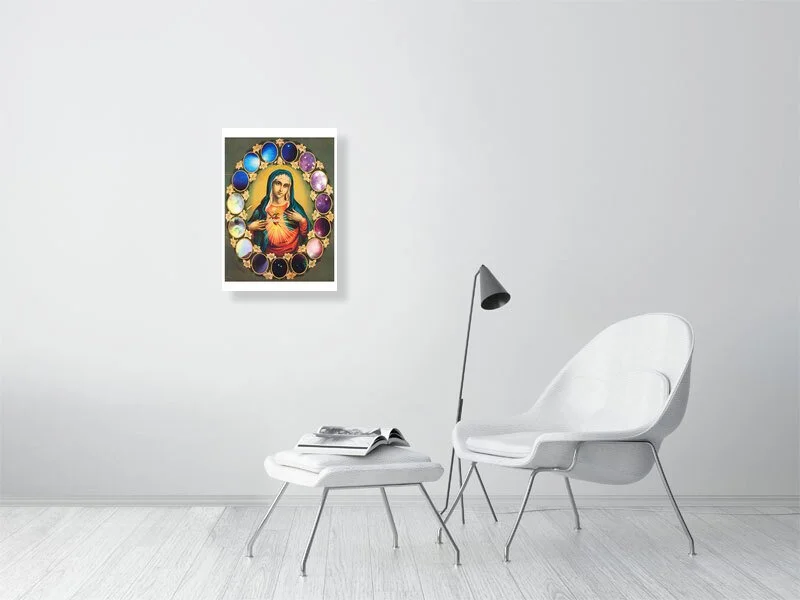
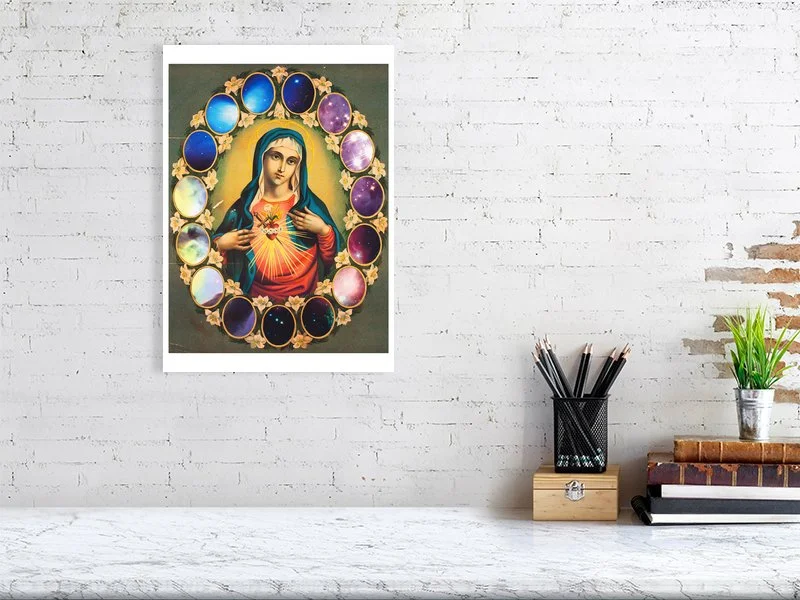
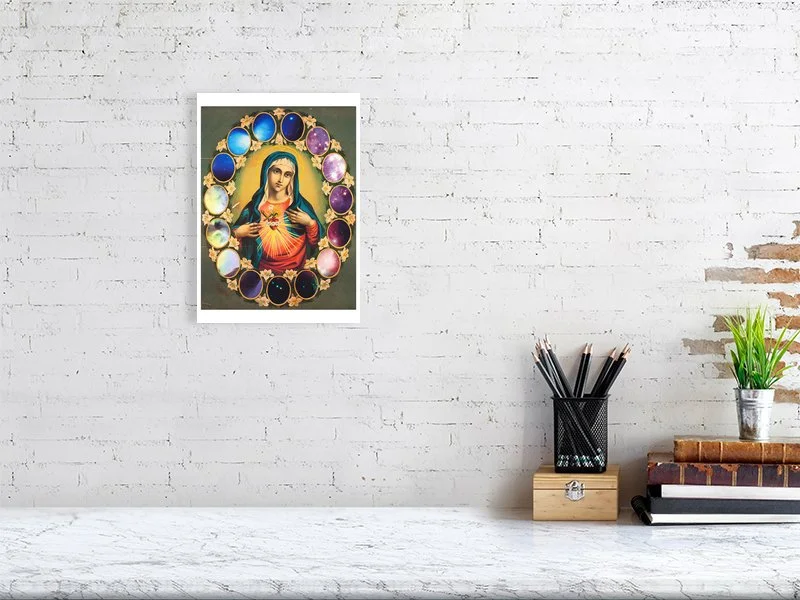
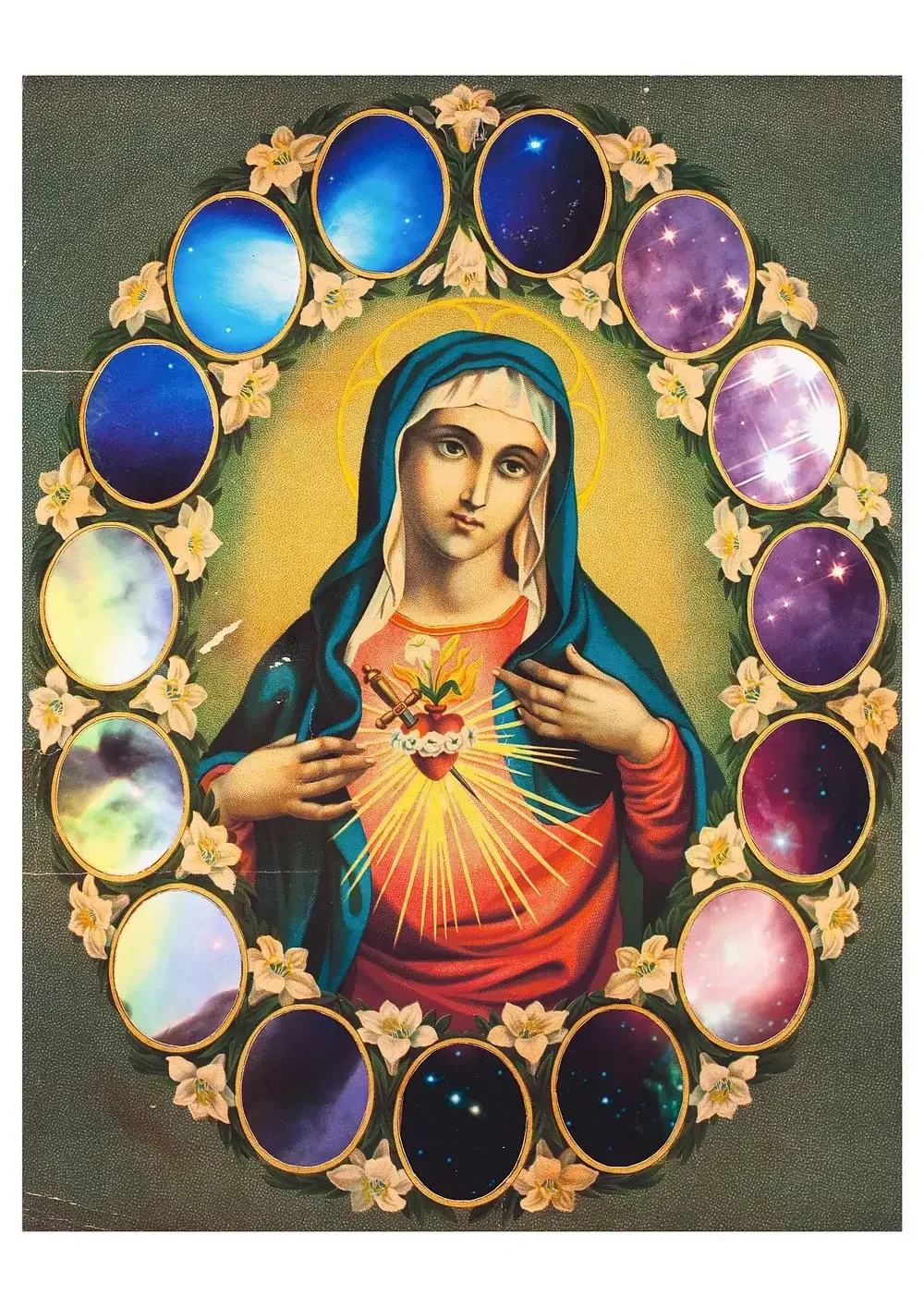
The Madonna, mother of Christ, presses her hands to her Sacred Heart — its starburst radiating golden light across her chest. This luminous Fine Art Print reproduces an original hand-cut paper collage by the artist Aleksandra Mir.
The new artwork combines source materials from antique religious and modern scientific imagery into a new physical and fantastical reality. The rosary-like structure of repeating ovals that would be a wreath of prayers becomes a string of cosmic windows. The Madonna's sacred heart now pulses outward into the universe itself. The piece equates spiritual devotion with scientific wonder — the cosmos is the sacred.
Giclée pigment ink on Hahnemühle German Etching paper results in a superior quality print with exceptional detail, vibrant color accuracy, and long-term durability. The fresh print reproduces an aged authentic patina and the imprint of the artist’s hand-crafted marks.
· Archival Museum Quality ·
· Limited Edition. 100 ·
· Certificate of Authenticity ·
· Hand & Human-Made without AI ·
· 100% Carbon Neutral ·
· Free Worldwide Shipping ·

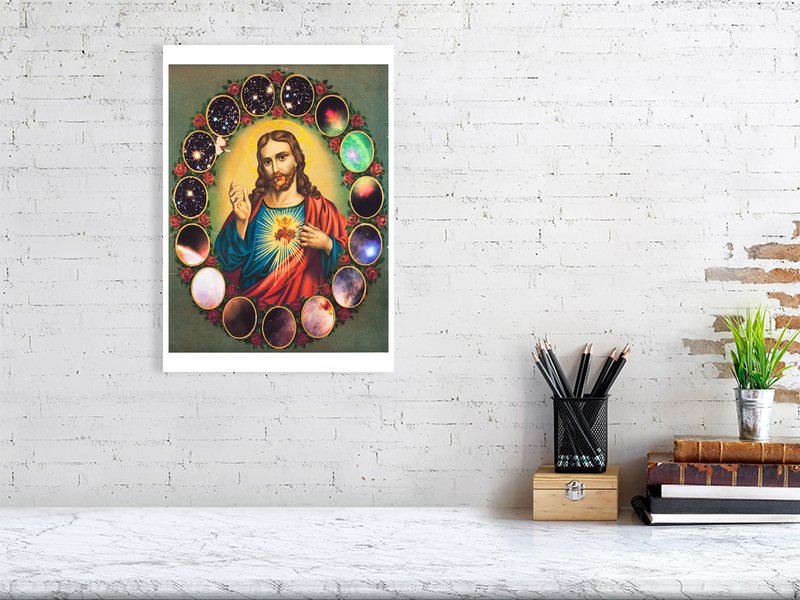

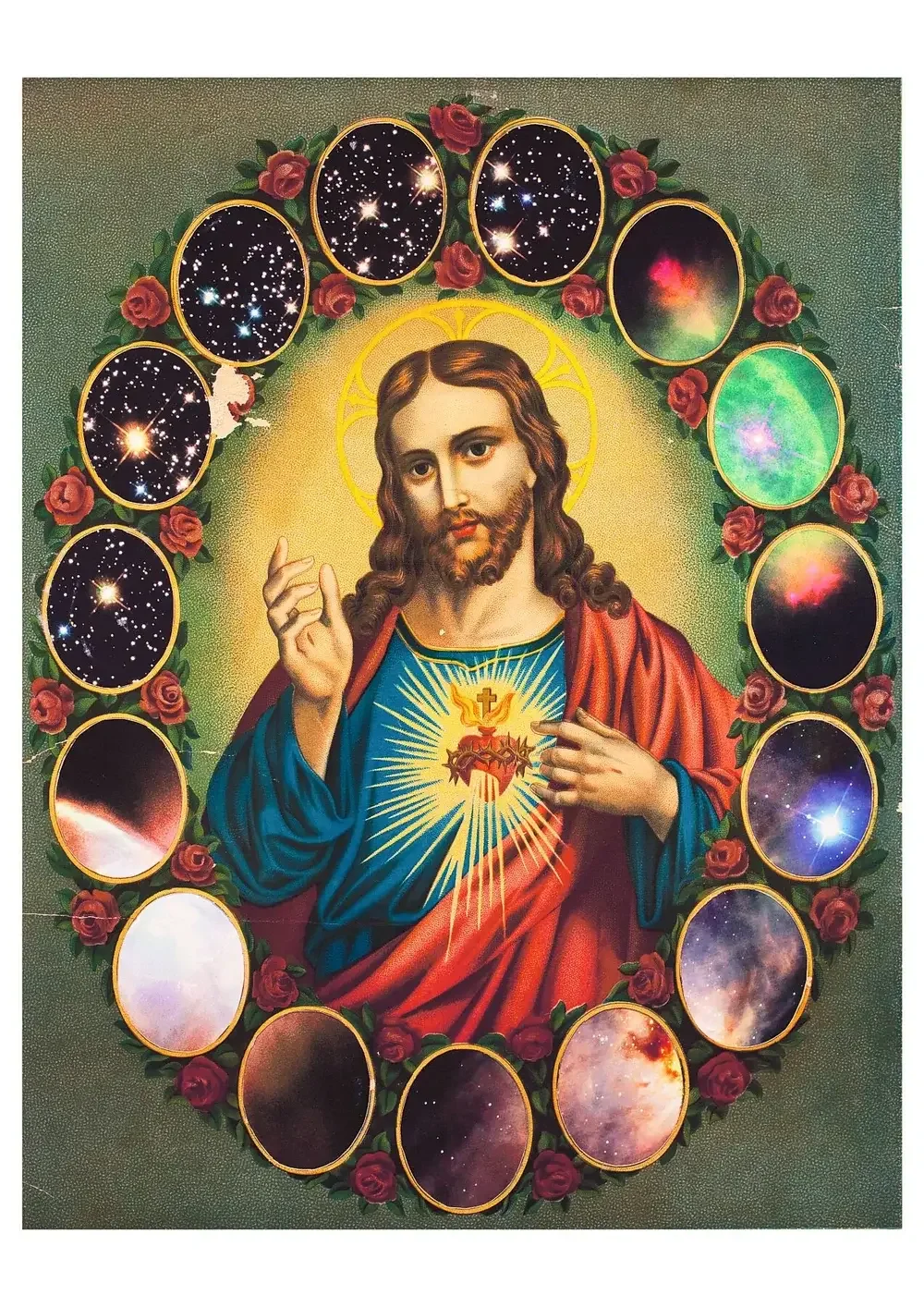
Jesus Christ surrounded by medallions holding the night sky — star clusters, nebulae and galaxies ablaze in the cosmos are depicted in deep blacks, greens, pinks and purples. This celestial Fine Art Print reproduces an original hand-cut paper collage by the artist Aleksandra Mir.
The new artwork combines source materials from antique religious and modern scientific imagery into a new physical and fantastical reality. It is based on a classic Sacred Heart of Jesus devotional print, where Christ raises one hand in blessing while pointing to his radiant, crowned heart. The surrounding wreath of oval medallions — in the original would be prayers or saints — has been collaged with astronomical images.
This is a companion piece to Cosmic Madonna — displayed together they form a diptych altarpiece. The Madonna and Christ side by side, each surrounded by visions of the entire universe. It's a quietly radical reimagining of devotional art that is both reverent and expansive.
Giclée pigment ink on Hahnemühle German Etching paper results in a superior quality print with exceptional detail, vibrant color accuracy, and long-term durability. The fresh print reproduces an aged authentic patina and the imprint of the artist’s hand-crafted marks.
· Archival Museum Quality ·
· Limited Edition. 100 ·
· Certificate of Authenticity ·
· Hand & Human-Made without AI ·
· 100% Carbon Neutral ·
· Free Worldwide Shipping ·
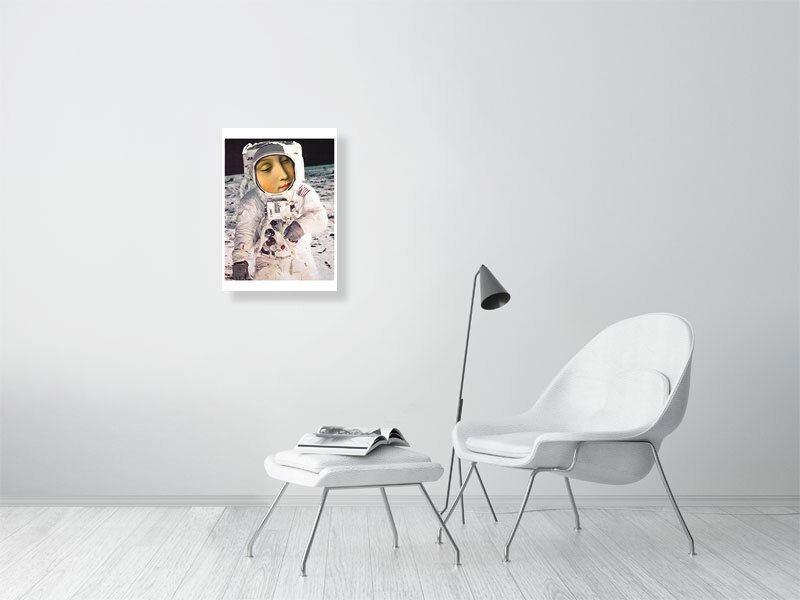
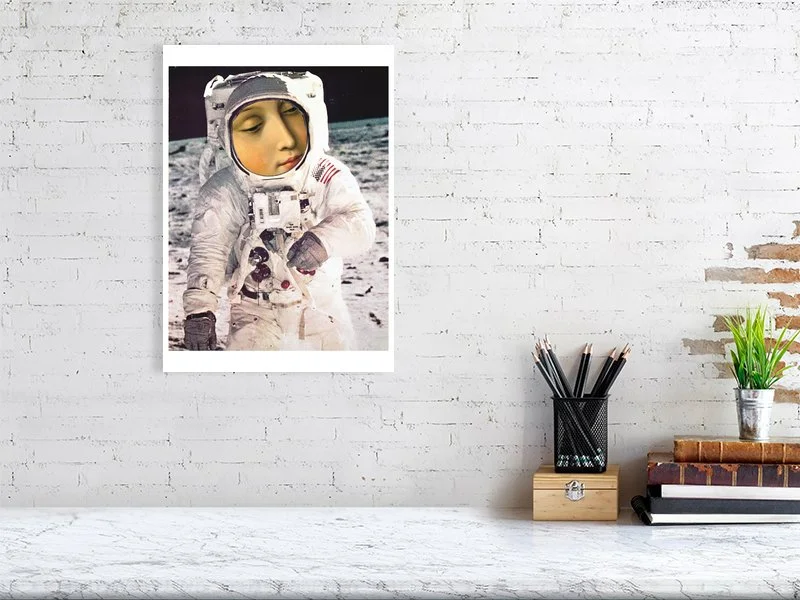

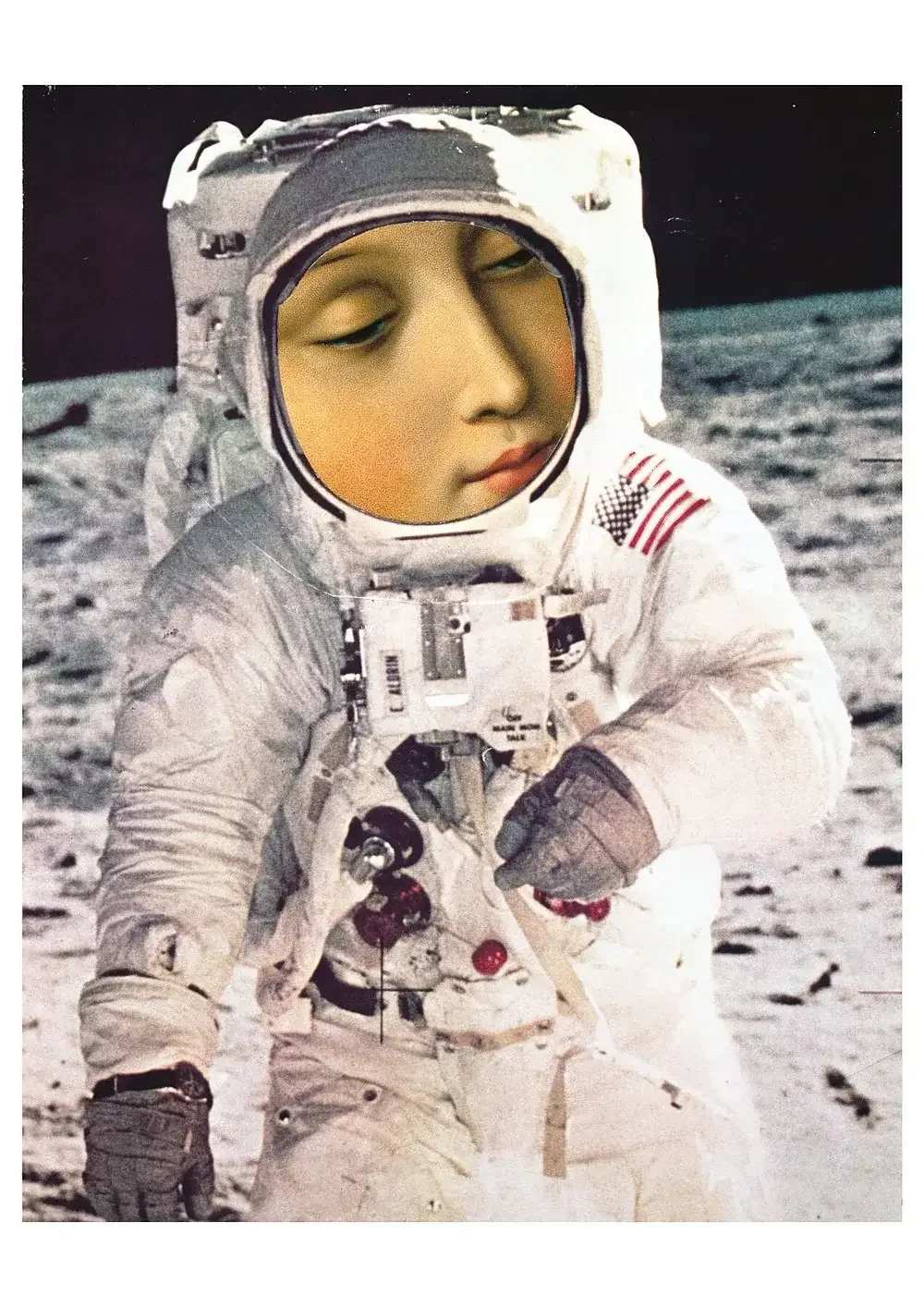
An astronaut with the face of a Saint has landed on the Moon. This is a Fine Art Print of an original hand-cut paper collage by Aleksandra Mir.
The new artwork combines source materials from antique religious and modern scientific imagery into a new physical and fantastical reality. The collage combines an iconic NASA Apollo-era photograph with a Renaissance-era painting. Both the Renaissance church and NASA's space programme represent the greatest collective ambitions of their respective ages — one reaching toward God, the other toward the cosmos. Both demanded total devotion, sacrifice, and the marshalling of the finest human minds and resources of their time. Both produced objects of transcendent beauty in the process. The saint and the astronaut are mirror images across five centuries.
By placing one inside the other, the work asks: have we simply replaced one form of devotion with another? Or were they always the same impulse — the human need to reach beyond the known world toward something greater than ourselves? The contrast between the technical, industrial spacesuit and the serene, almost meditative expression of the painterly saint’s face is quietly profound. It suggests innocence, wonder, or perhaps the inner life behind great human endeavour.
Giclée pigment ink on Hahnemühle German Etching paper achieves a superior quality print with exceptional detail, vibrant color accuracy, and long-term durability. The fresh print reproduces an aged authentic patina and the imprint of the artist’s hand-crafted marks.
· Archival Museum Quality ·
· Limited Edition. 100 ·
· Certificate of Authenticity ·
· Hand & Human-Made without AI ·
· 100% Carbon Neutral ·
· Free Worldwide Shipping ·
Frequently Asked Questions
-
Aleksandra Prints are museum-quality reproductions of original hand-cut antique paper collages by artist Aleksandra Mir, created in her Palermo, Sicily studio in 2007–2009 and exhibited internationally for two decades.
Aleksandra Prints started on the initiative of an audience member who discovered the original artworks in an exhibition and asked for affordable reproductions.
What is a collage?
A collage combines elements from different sources into a new image and physical reality.
The materials for these collages were sourced from antique dealers and second-hand bookshops. As such, the fresh print reproduces a patina with authentic wear and tear.
Furthermore, in creating the collages, the artist sliced and tore through the source materials leaving the imprint of her hand-crafted marks.100% human-made. No AI was used in the creation of these artworks.
-
Giclée print on Hahnemühle German Etching paper
Giclée (pronounced "g-clay") comes from the French gicler — "to spray." The process uses high-resolution inkjet printing, pigment-based inks and acid free papers to deliver a superior quality print with exceptional detail, vibrant colour accuracy, and lasting durability.
Hahnemühle German Etching is a traditional mould-made copperplate paper. Crafted from 100% alpha cellulose, it has a distinctively velvety feel and fine felt texture that brings images to life with a striking three-dimensional depth. Acid- and lignin-free, it meets the highest standards of age resistance.
-
Aleksandra Prints come in three standard formats, Small, Medium and Large:
A4 (S) – 21 x 30cm / 8.3 x 11.7"
A3 (M) – 30 x 42cm / 11.7 x 16.5"
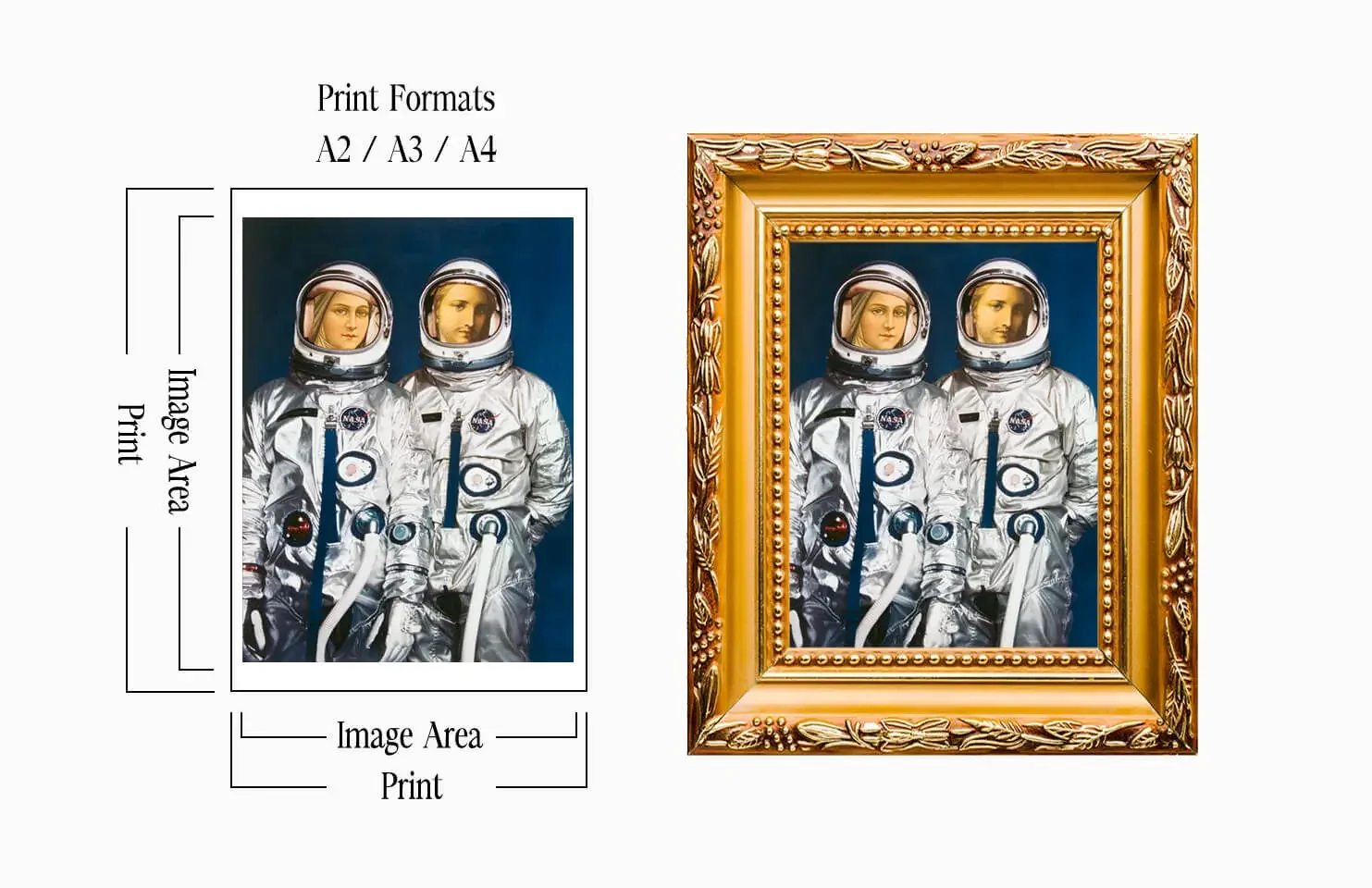
A2 (L) – 42 x 59cm / 16.5 x 23.4"Please note that each original collage was created in a unique format and the image areas within the prints therefore slightly vary. The image areas are surrounded by white space to create the uniform print formats: A2, A3 or A4.
You can keep the white space, extend it with a mat or crop it out when framing.
-
Aleksandra Prints are only available from this website, www.aleksandraprints.com
Each print comes with a signed and numbered Certificate of Authenticity that holds a 3D embossing.
We are able to confirm the first sale provenance of every print.
-
Aleksandra Prints does not offer framing because shipping artwork behind glass is both risky and expensive. It is much better to have your print framed closer to home.
We recommend these three style options:
Minimalist – A ‘frameless’ clip frame in glass or acrylic in standard A4, A3 or A2 formats that match the prints sizes exactly. These type of frames are easily available in shops and can be ordered online.
Mediumalist – Adding a larger white or colored mat to extend the white space around the image area up to any preferred size. This framing method protects the print by allowing some air between print and glass. Select any custom-sized frame and profile from a framer of your choice.
Maximalist - New or antique Gold, Bronze or Silver custom made frames with a different profile for each print. Visit a local framer to explore their profiles or source frames from markets and antique shops.
-
Aleksandra Prints offers FREE shipping worldwide.
Our prints are produced in and shipped from the United Kingdom by Royal Mail.
Production & Delivery:
(UK) 7 days
(EU/USA) 14 days
(Rest of the World) Pending Location.
Tracking: All orders are dispatched within 48 hours. As soon as a print is shipped you will receive an email with tracking details for your order.Customs Fees & Taxes:
UK orders: No VAT.
USA orders: No sales tax or tariffs.EU orders may be subject to local import VAT and a small customs handling fee payable on delivery. These charges are set by your country’s customs/courier and are not collected by us. The commodity code 4911 91 00 refers to pictures under the category of printed matter with a charge that can vary between ~7–27% of the order value. Please refer to your local customs office for the exact rate.
Some countries — including Brazil, Argentina, Indonesia, South Africa, Chile, Mexico, and others — may charge import duties, VAT, or customs clearance fees. These are not included in your payment and must be paid by the recipient upon delivery.
Contact us
Here to help and to answer your questions! -
Return Policy
All sales are final. Each print is made to order and numbered exclusively for you, so we are unable to accept returns. But if anything arrives damaged, we will make it right.We offer replacement prints if the product arrives damaged or is significantly delayed (postage delays which could be considered normal, or delays due to items being held up in customs will not be refunded).
Significant Delays
Although most orders arrive without any issue, some can be delayed. We will do our best to help find out what the issue is, but only after these times have passed can we make a claim with Royal Mail for loss and offer a replacement:
UK: 10 days
Europe: 25 days
Rest of the World: 32 daysDamaged prints
In the unlikely event the print arrives to you damaged, we will send a replacement free of charge. To arrange this please contact us within max 2 days with photos of the damaged print and its packaging.
We value your custom and thank you for your understanding and cooperation!
-
Aleksandra Prints are produced in the UK by a small 100% carbon neutral print facility, which means they minimise energy usage, use renewables, and offset the remaining emissions by investing in renewable energy projects.
Our paper manufacturer only use resources from sustainable forest management areas. This programme ensures the preservation and protection of biodiversity, the renewal of the forests habitats and decreasing of the impacts of exploitation of forest areas for future generations.
All the packaging used for our customer orders are a mixture of sustainably sourced, recyclable or biodegradable materials.