
Press Release
Whitney Museum of American Art
October, 2011
“If angels and astronauts share the same sky, isn’t it time they were introduced?”
By Carter Foster
Engaging in a dialogue with the seventeenth-century Italian “father of modern science,” the London-based artist Aleksandra Mir is presenting The Seduction of Galileo Galilei (2011) at the Whitney Museum of American Art. Mir’s new video work documents a Galileo-inspired gravitational experiment along with a selection of collages from Mir’s series The Dream and the Promise (2008–09), combining religious iconography with that of space travel.
Mir’s projects are typically interactive and draw on her interests in technology, religion, media, and concepts of distance and place. Her work on projects, performances, and publications takes her into communities and art spaces around the world; a dual citizen of the United States and Sweden, Mir has lived in New York City, Palermo, and London. In their ample scale, affinity for spectacle, and engagement with landscape, Mir’s works often recall the site-specific land art of such artists as Robert Smithson and Michael Heizer.
In The Seduction of Galileo Galilei (2011), Mir conducts a dialogue with the seventeenth-century Italian scientist, mathematician, and philosopher. The documentary video on view, set to a Baroque soundtrack, takes the narrative of Galileo’s achievement and historical authority as its starting point—complicating and extending the cultural myth with which Mir’s playful, participatory experiment engages. The artist performs a gravitational experiment inspired by Galileo’s apocryphal test of the law of falling bodies. Rather than dropping objects from the top of the Leaning Tower in Pisa, as Galileo is said to have done in his observations of gravity’s effect on objects of differing masses, Mir and her team attempted to build their own tower. In the gravel pit of a go-kart track in Stouffville, Ontario, Mir worked with crane operators and volunteers to stack tires as high as possible in a precarious, lilting spire.
Galileo Galilei (1564–1642) was a devout Catholic; however, his investigations into astronomy and cosmology, particularly his advocacy of Copernicus’s theory that the Earth orbits the sun, set him at odds with the Church and its doctrines, leading to a charge of heresy in 1633. As Sarah Robayo Sheridan, the curator who commissioned this work for Mercer Union, Toronto, described the artist’s role: “A corrupting femme fatale, [Mir] solicits an intellectual affair with a man almost four centuries her senior, in order to explore, exploit, and liberate the void in the telling of the myth.”
Also on view are collages from Mir’s 2008–09 series The Dream and the Promise. Interweaving and juxtaposing depictions of religious figures and iconography with images of space and space travel, these works relate to the artist’s question, “If angels and astronauts share the same sky, isn’t it time they were introduced?” Her seamless melding of the parallel visual vocabularies of science and faith alludes to the complicated relationship between the two traditions, and their different ways of understanding our world.
The Seduction of Galileo Galilei was commissioned by Mercer Union: A Centre for Contemporary Art, Toronto.
Aleksandra Mir was born in Lublin, Poland, in 1967, and is a dual citizen of Sweden and the United States. She received her BFA at the School for Visual Arts, New York in 1992, and from 1994 to 1996 studied cultural anthropology at the Graduate Faculty of the New School for Social Research, New York. Mir currently lives and works in London, England. Since 1995 her work has been shown in numerous solo and group exhibitions in the United States and Europe including the Venice Biennale (2009) and the Whitney Biennial (2004). Mir has also published many artists’ books. Her work is included in important public collections such as the Tate Modern, London, and Kunsthaus Zürich, as well as the Whitney Museum of American Art, New York. Mir’s work can also be seen in Singular Visions, on the fifth floor of the Museum.

Build Your Collection
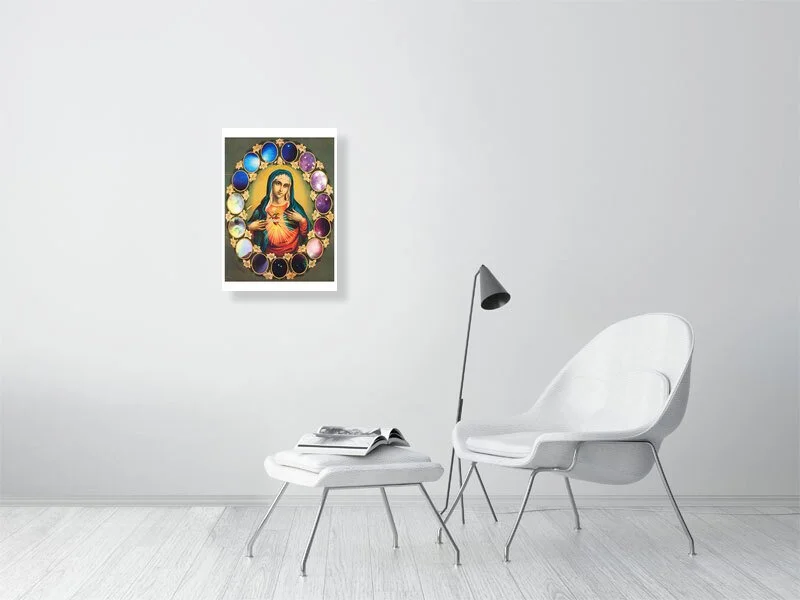
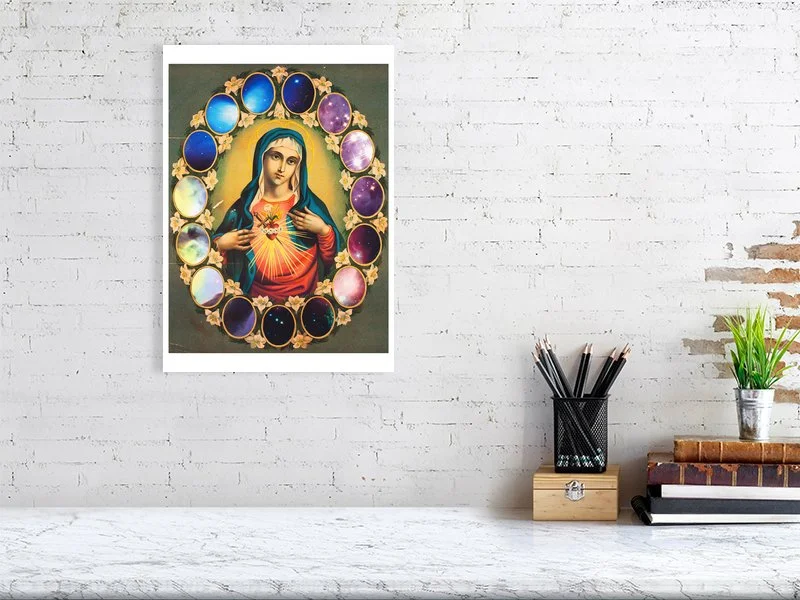
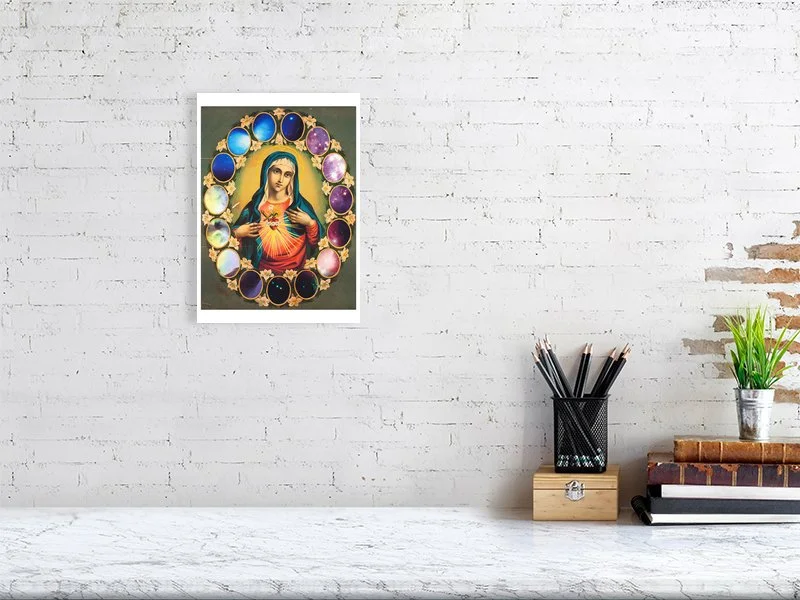
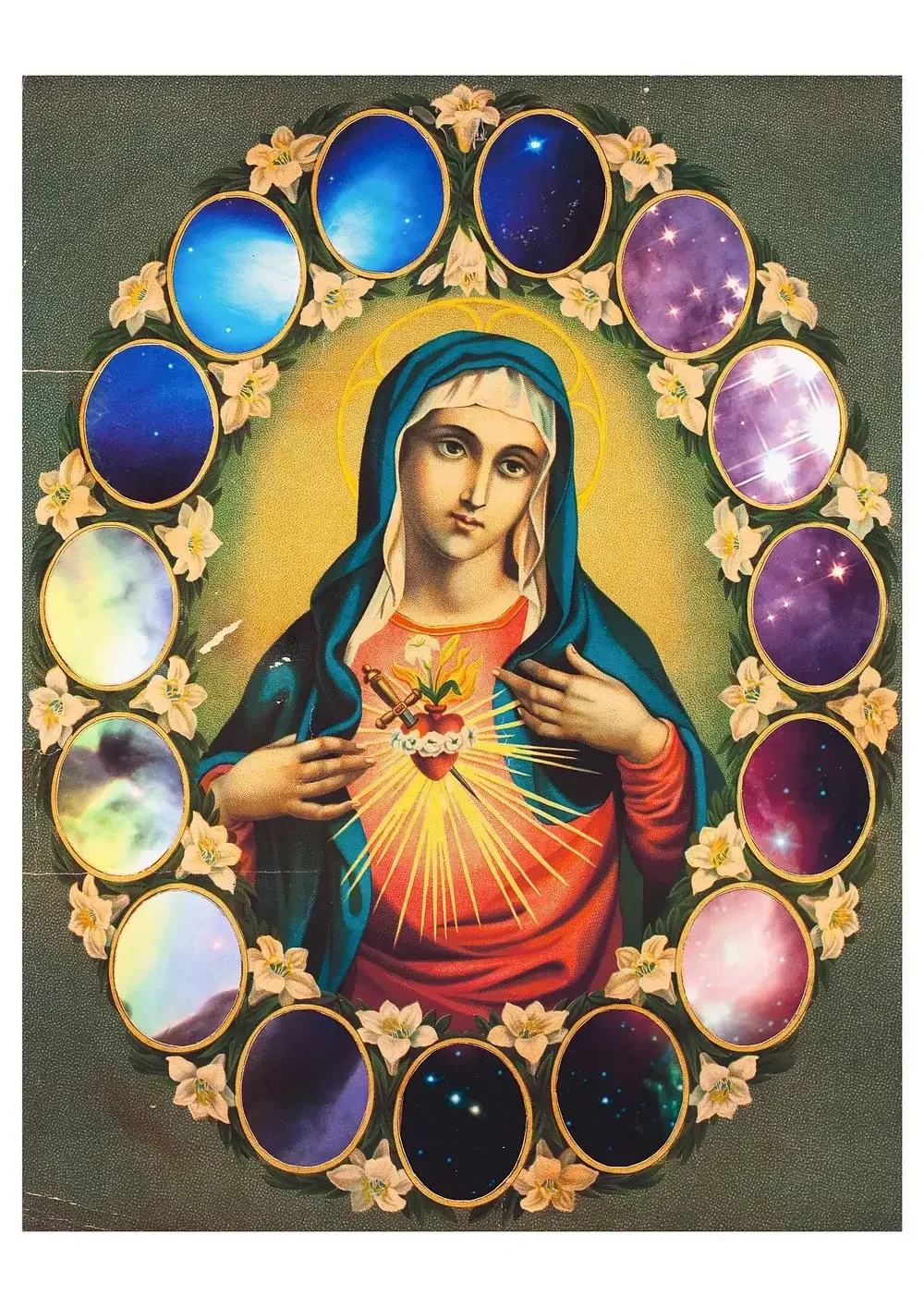
The Madonna, mother of Christ, presses her hands to her Sacred Heart — its starburst radiating golden light across her chest. This luminous Fine Art Print reproduces an original hand-cut paper collage by the artist Aleksandra Mir.
The new artwork combines source materials from antique religious and modern scientific imagery into a new physical and fantastical reality. The rosary-like structure of repeating ovals that would be a wreath of prayers becomes a string of cosmic windows. The Madonna's sacred heart now pulses outward into the universe itself. The piece equates spiritual devotion with scientific wonder — the cosmos is the sacred.
Giclée pigment ink on Hahnemühle German Etching paper results in a superior quality print with exceptional detail, vibrant color accuracy, and long-term durability. The fresh print reproduces an aged authentic patina and the imprint of the artist’s hand-crafted marks.
· Archival Museum Quality ·
· Limited Edition. 100 ·
· Certificate of Authenticity ·
· Hand & Human-Made without AI ·
· 100% Carbon Neutral ·
· Free Worldwide Shipping ·

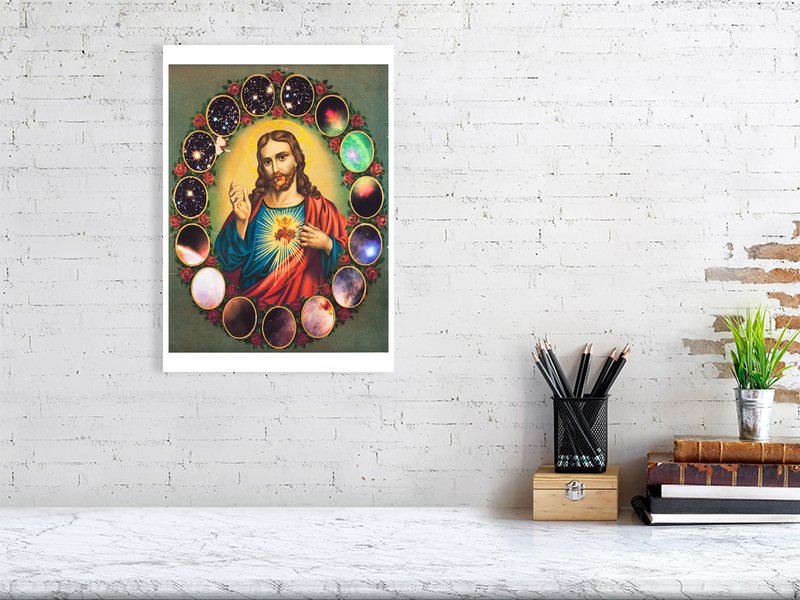

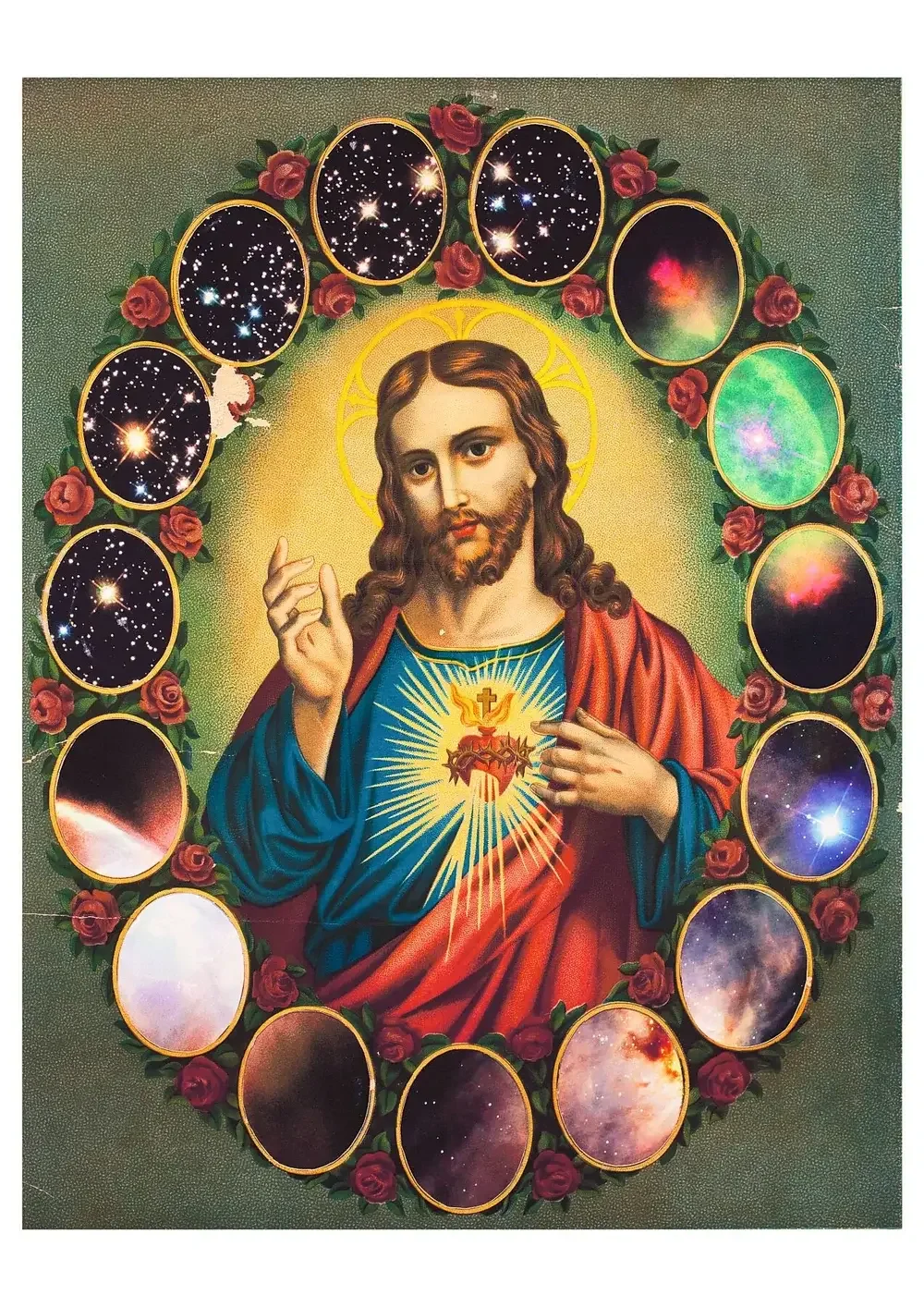
Jesus Christ surrounded by medallions holding the night sky — star clusters, nebulae and galaxies ablaze in the cosmos are depicted in deep blacks, greens, pinks and purples. This celestial Fine Art Print reproduces an original hand-cut paper collage by the artist Aleksandra Mir.
The new artwork combines source materials from antique religious and modern scientific imagery into a new physical and fantastical reality. It is based on a classic Sacred Heart of Jesus devotional print, where Christ raises one hand in blessing while pointing to his radiant, crowned heart. The surrounding wreath of oval medallions — in the original would be prayers or saints — has been collaged with astronomical images.
This is a companion piece to Cosmic Madonna — displayed together they form a diptych altarpiece. The Madonna and Christ side by side, each surrounded by visions of the entire universe. It's a quietly radical reimagining of devotional art that is both reverent and expansive.
Giclée pigment ink on Hahnemühle German Etching paper results in a superior quality print with exceptional detail, vibrant color accuracy, and long-term durability. The fresh print reproduces an aged authentic patina and the imprint of the artist’s hand-crafted marks.
· Archival Museum Quality ·
· Limited Edition. 100 ·
· Certificate of Authenticity ·
· Hand & Human-Made without AI ·
· 100% Carbon Neutral ·
· Free Worldwide Shipping ·
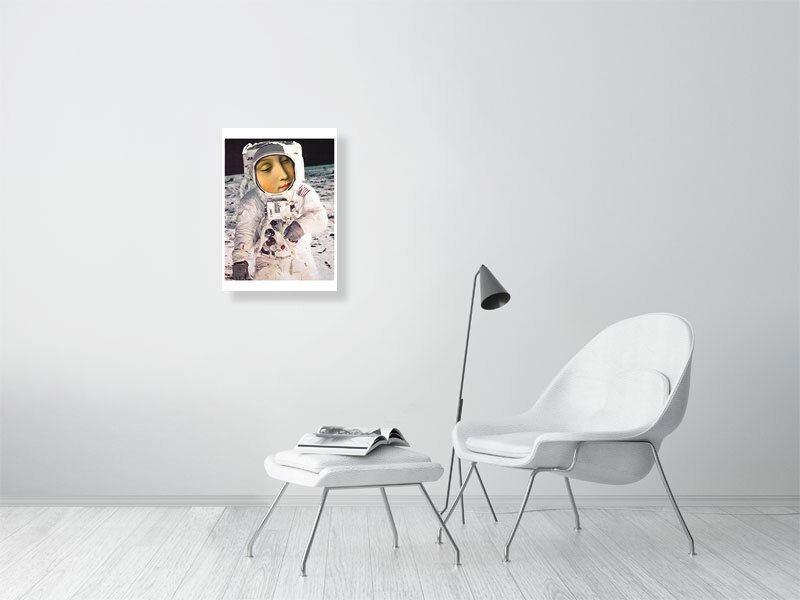
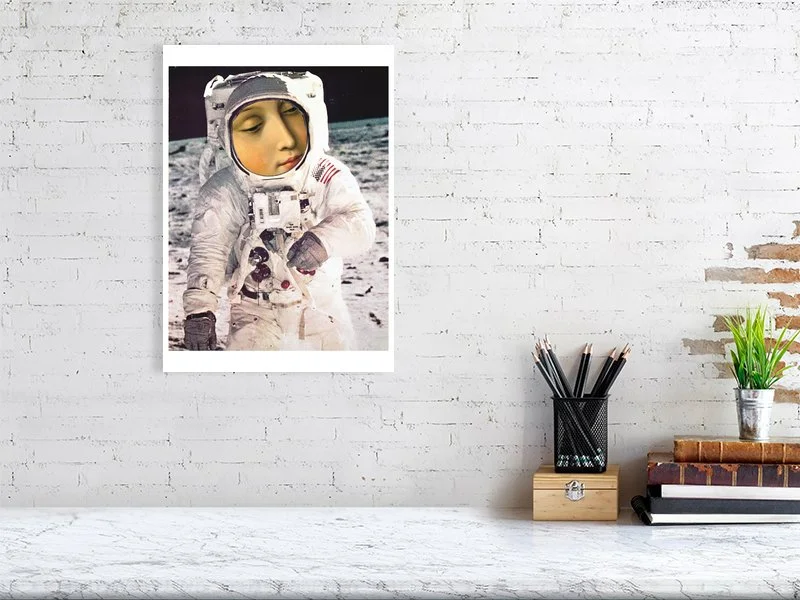

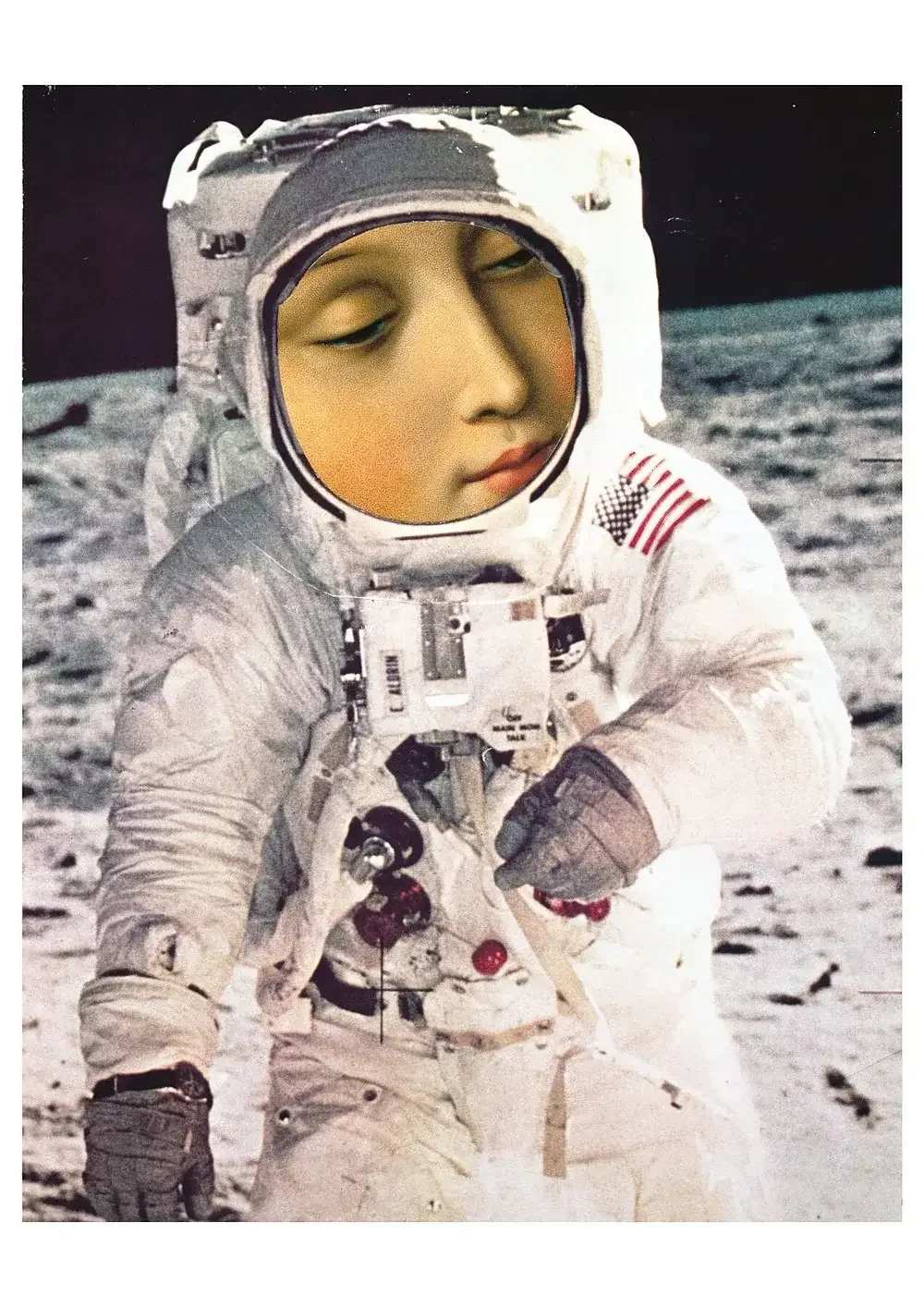
An astronaut with the face of a Saint has landed on the Moon. This is a Fine Art Print of an original hand-cut paper collage by the artist Aleksandra Mir.
The new artwork combines source materials from antique religious and modern scientific imagery into a new physical and fantastical reality. The collage combines an iconic NASA Apollo-era photograph with a Renaissance-era painting. Both the Renaissance church and NASA's space programme represent the greatest collective ambitions of their respective ages — one reaching toward God, the other toward the cosmos. Both demanded total devotion, sacrifice, and the marshalling of the finest human minds and resources of their time. Both produced objects of transcendent beauty in the process. The saint and the astronaut are mirror images across five centuries.
By placing one inside the other, the work asks: have we simply replaced one form of devotion with another? Or were they always the same impulse — the human need to reach beyond the known world toward something greater than ourselves? The contrast between the technical, industrial spacesuit and the serene, almost meditative expression of the painterly saint’s face is quietly profound. It suggests innocence, wonder, or perhaps the inner life behind great human endeavour.
Giclée pigment ink on Hahnemühle German Etching paper results in a superior quality print with exceptional detail, vibrant color accuracy, and long-term durability. The fresh print reproduces an aged authentic patina and the imprint of the artist’s hand-crafted marks.
· Archival Museum Quality ·
· Limited Edition. 100 ·
· Certificate of Authenticity ·
· Hand & Human-Made without AI ·
· 100% Carbon Neutral ·
· Free Worldwide Shipping ·
Frequently Asked Questions
-
A collage combines elements from different sources into a new image and physical reality. The physical materials for the original collages were sourced from antique dealers and second-hand bookshops. As such, the fresh print reproduces a patina with authentic wear and tear. Furthermore, in creating the collages, the artist sliced and tore through the source materials leaving the imprint of her hand-crafted marks.
Aleksandra Prints are museum-quality reproductions of original hand-cut antique paper collages by artist Aleksandra Mir.
The collages were created in the artist’s Palermo, Sicily studio in 2007-2009 and exhibited internationally in galleries and museums for the past two decades. Today, most originals are part of private and permanent public collections.
Aleksandra Prints started on the initiative of an audience member who discovered the original artworks in an exhibition and asked for affordable reproductions.
100% human-made. No AI was used in the creation of these artworks.
-
Giclée print on Hahnemühle German Etching paper
The word Giclée (“g-clay”) is derived from the French verb gicler, meaning “to squirt or spray”. It is a process that uses high-resolution inkjet printers, pigment-based inks and acid free papers to achieve a superior quality print with exceptional detail, vibrant color accuracy, and long-term durability.
Hahnemühle German Etching is a traditional mould-made copperplate printing paper. The white art paper made from 100% alpha cellulose is characterized by its extraordinary velvety tactile feel and its fine, clearly defined felt structure. The unique surface texture adds a very special touch to images, showcasing them in all their splendour with impressive three-dimensional effect and depth. German Etching is acid- and lignin-free and meets the most exacting requirements in terms of age resistance.
-
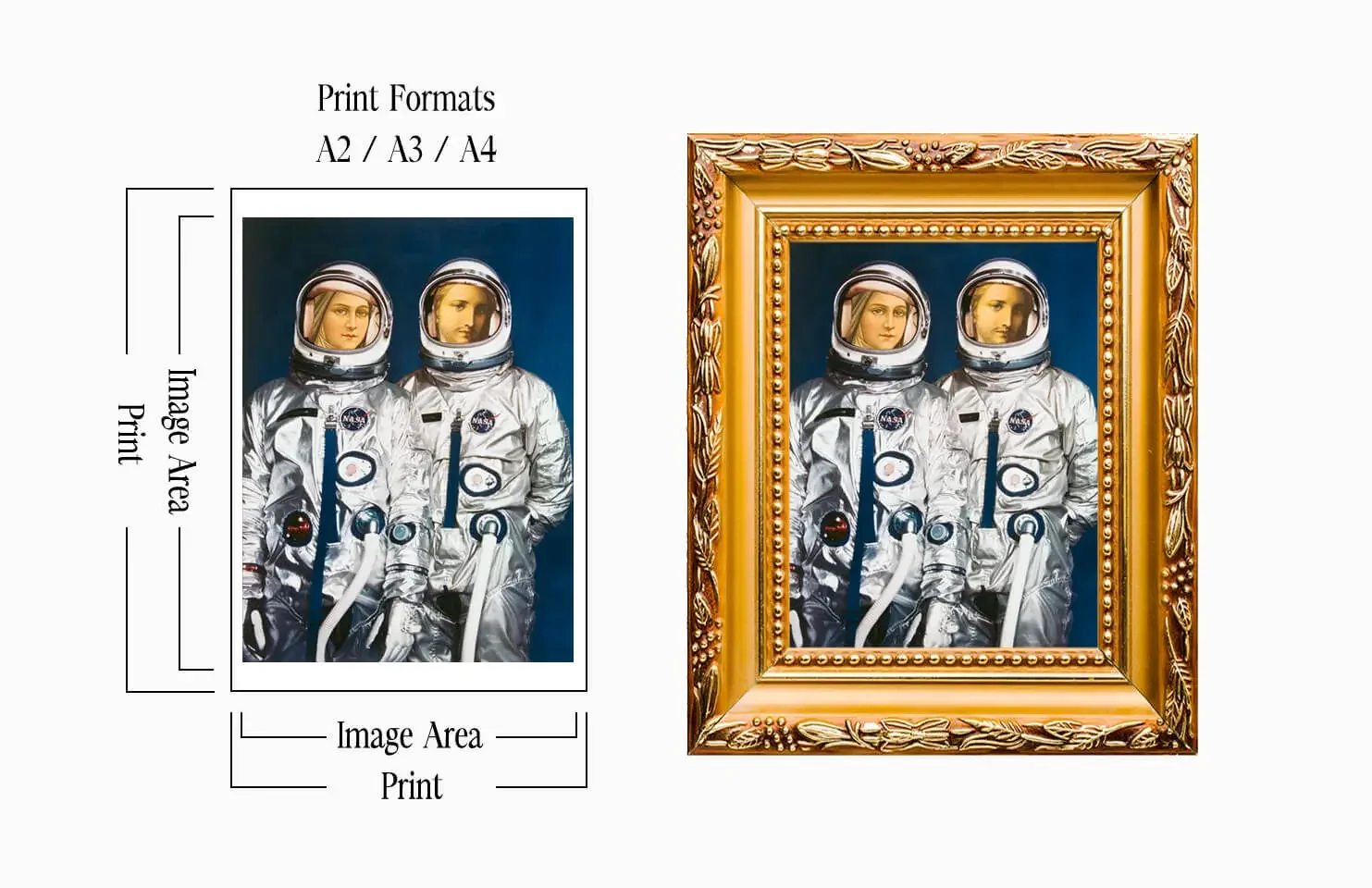
Aleksandra Prints come in three standard formats, Small, Medium and Large:
A4 (S) – 21 x 30cm / 8.3 x 11.7"
A3 (M) – 30 x 42cm / 11.7 x 16.5"
A2 (L) – 42 x 59cm / 16.5 x 23.4"Please note that each original collage was created in a unique format and the image areas within the prints therefore slightly vary. The image areas are surrounded by white space to create the uniform print formats: A2, A3 or A4.
You can keep the white space, extend it with a mat or crop it out when framing.
-
Aleksandra Prints are only available from this website, www.aleksandraprints.com
Each print comes with a signed and numbered Certificate of Authenticity that holds a 3D embossing.
We are able to confirm the first sale provenance of every print.
-
Aleksandra Prints does not offer framing because shipping artwork behind glass is both risky and expensive. It is much better to have your print framed closer to home.
We recommend these three style options:
Minimalist – A ‘frameless’ clip frame in glass or acrylic in standard A4, A3 or A2 formats that match the prints sizes exactly. These type of frames are easily available in shops and can be ordered online.
Mediumalist – Adding a larger white or colored mat to extend the white space around the image area up to any preferred size. This framing method protects the print by allowing some air between print and glass. Select any custom-sized frame and profile from a framer of your choice.
Maximalist - New or antique Gold, Bronze or Silver custom made frames with a different profile for each print. Visit a local framer to explore their profiles or source frames from markets and antique shops.
-
Aleksandra Prints offers FREE shipping worldwide.
Our prints are produced in and shipped from the United Kingdom by Royal Mail.
Production & Delivery (UK) 7 days (EU/USA) 14 days (Rest of the World) Pending Location.
As soon as a print is shipped you will receive an email with tracking details for your order.Customs Fees & Taxes:
UK orders: No VAT.
USA orders: No sales tax or tariffs.EU orders may be subject to local import VAT and a small customs handling fee payable on delivery. These charges are set by your country’s customs/courier and are not collected by us. The commodity code 4911 91 00 refers to pictures under the category of printed matter with a charge that can vary between ~7–27% of the order value. Please refer to your local customs office for the exact rate.
Some countries — including Brazil, Argentina, Indonesia, South Africa, Chile, Mexico, and others — may charge import duties, VAT, or customs clearance fees. These are not included in your payment and must be paid by the recipient upon delivery.
Contact us
Here to help and to answer your questions! -
Return Policy
All sales are final. Each print is made to order and numbered exclusively for you, so we're unable to accept returns. If anything arrives damaged, we'll make it right.
We offer replacement prints if the product arrives damaged or is significantly delayed (postage delays which could be considered normal, or delays due to items being held up in customs will not be refunded).
Significant Delays
Although most orders arrive without any issue, some can be delayed. We will do our best to help find out what the issue is, but only after these times have passed can we make a claim with Royal Mail for loss and offer a replacement:
UK: 10 days
Europe: 25 days
Rest of the World: 32 daysDamaged prints
In the unlikely event the print arrives to you damaged, we will send a replacement free of charge. To arrange this please contact us within max 2 days with photos of the damaged print and its packaging.
We value your custom and thank you for your understanding and cooperation!
-
Aleksandra Prints are produced in the UK by a small 100% carbon neutral print facility, which means they minimise energy usage, use renewables, and offset the remaining emissions by investing in renewable energy projects.
Our paper manufacturer only use resources from sustainable forest management areas. This programme ensures the preservation and protection of biodiversity, the renewal of the forests habitats and decreasing of the impacts of exploitation of forest areas for future generations.
All the packaging used for our customer orders are a mixture of sustainably sourced, recyclable or biodegradable materials.