
Sacred Fictions
La Vanguardia, Barcelona, November 2009
“Her fiction in these series is to mix the promises made to believers about life in the hereafter with all kinds of artefacts from Earth created by humans in the here and now”
By Jesús Martínez Clàra
The Dream and the Promise is the title of Aleksandra Mir's exhibition at Joan Prats. During her previous stint at the gallery, she offered us various indications of travel with her installation Aeropuerto (2005), a work that culminated in her sculpture Plane Landing (2008), a twenty-meter inflatable airplane that she landed and photographed deflated and limp in various European cities.
There is no doubt that Aleksandra likes to travel: born in Poland, she has been a Swedish and American citizen and currently lives in Palermo.
Her creative hyperactivity has led her to work on more than a hundred very diverse and complex projects over the last fifteen years. In all of them, there is a strong concern for social and gender issues, but what she likes most is living on the border between reality and fiction, between dreams and promises.
In her celebrated Gravity (2006), she began to prepare her journey into the universe with a new fiction, honoring the classical idea that what we cannot possess is given to us by art. She spent five months building a twenty-meter rocket out of industrial waste, a contraption that he has never stopped cultivating through a wide variety of media: performances, videos, texts, interviews, photography, books, black-and-white drawings, and, as in the current exhibition, collage.
This concern for space exploration has led her to create the series she is exhibiting today under the title Dreams and Promise. She began this series in 2008, when she pointed the bow of her desire toward the starry sky and outer space with Aim at the Stars, Declaration for Space, and Made in Heaven, collages of various dimensions mounted with gold leaf frames.
Her fiction in these series is to mix the promises made to believers about life in the hereafter with all kinds of artefacts from Earth created by humans in the here and now. Let's say she wants to demonstrate, in a Heideggerian way, the beneficial encounter between metaphysics and physics. To do this, she uses images of space travel as if it were a search for cosmological proof of God's existence.
She attempts to reconcile humans' dreams of conquering outer space with the religious promises of the Christian faith, bringing together the achievements of scientific progress on earth with the celestial and authentic inhabitants of outer space: angels, virgins, and even the Sacred Heart of Jesus himself.
Viewers are likely to be left with a sense of doubt about the degree of conviction or irony conveyed by Aleksandra's fictions. But it is worth noting that irony is nothing more than a strategy of human knowledge that protects us from everything that frightens us. Aleksandra's fictions, her dreams and promises, address these fascinating mysteries.

Build Your Collection
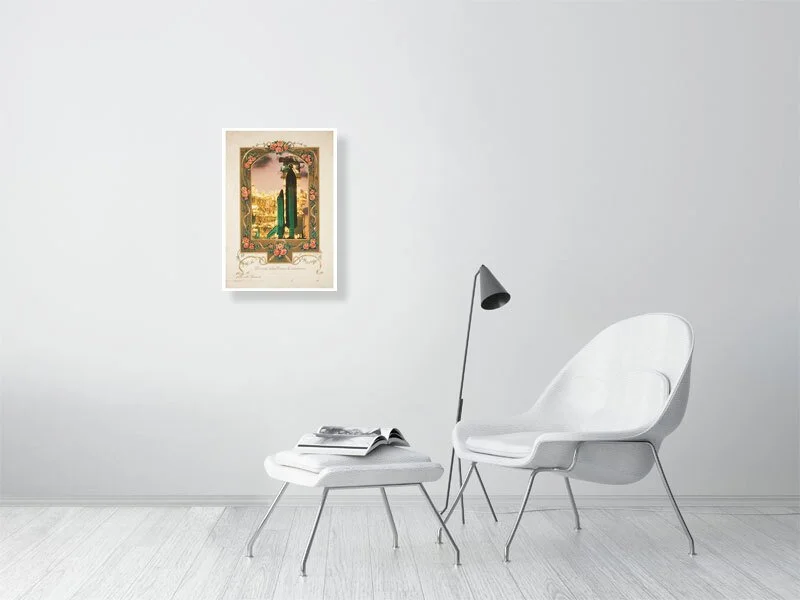
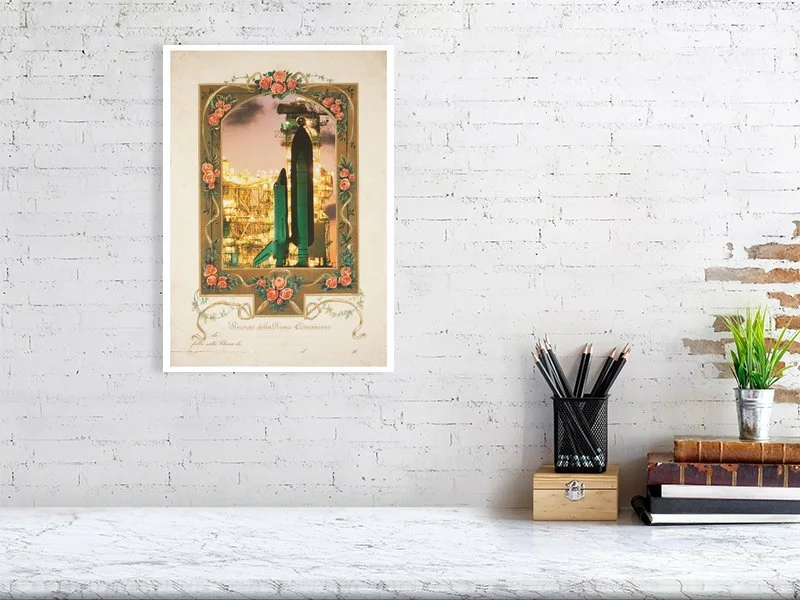
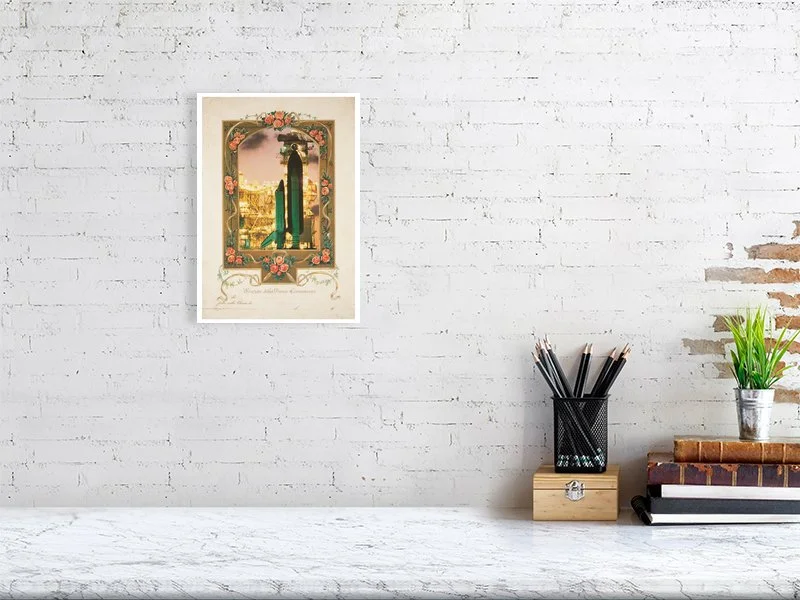
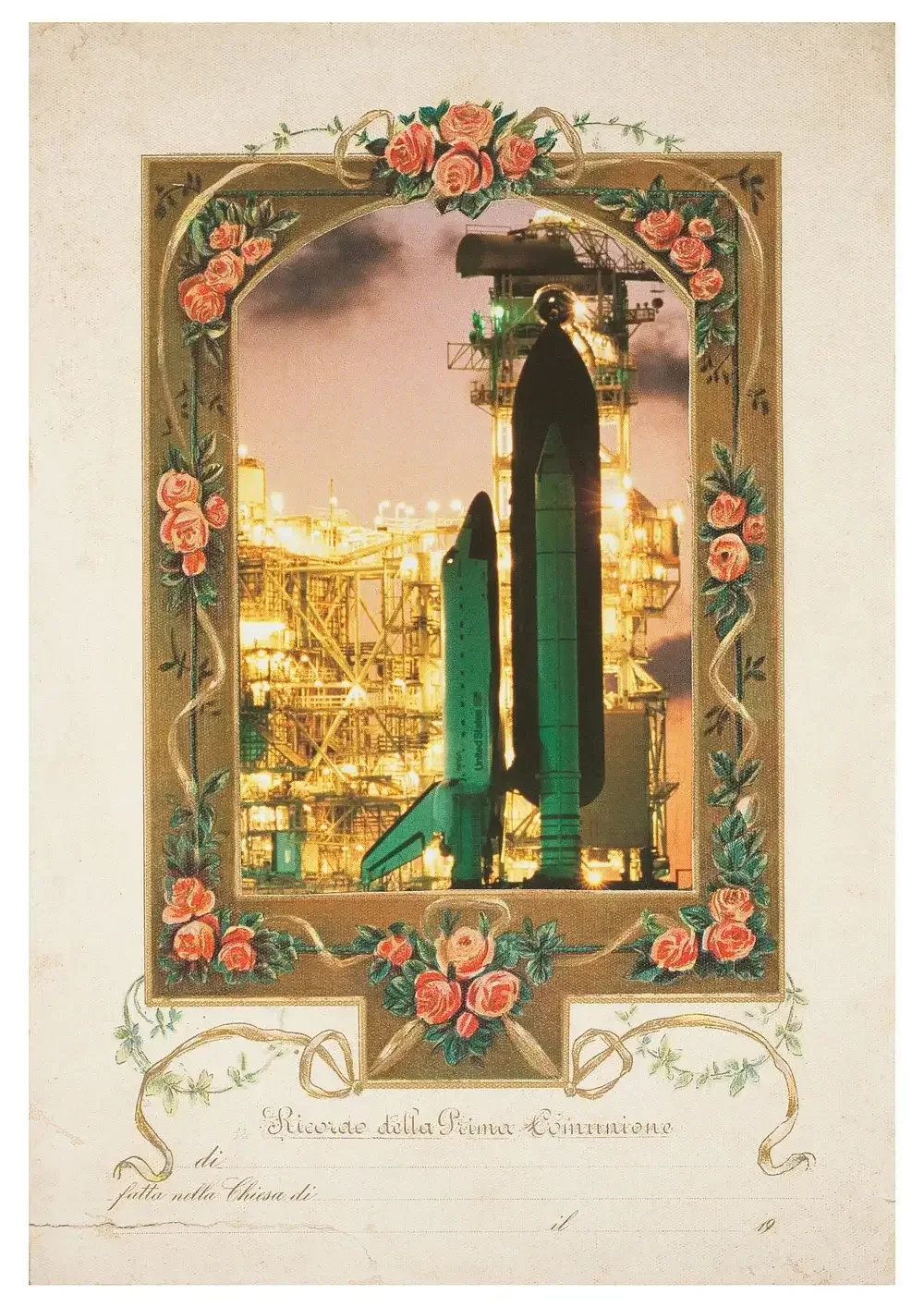
An Italian First Communion certificate, framed with a delicate border of pink roses, gold ribbons and green ivy, becomes the setting for a Space Shuttle on its launch pad — bathed in golden floodlights against a dusky sky. This wondrous Fine Art Print reproduces an original hand-cut paper collage by the artist Aleksandra Mir.
The new artwork combines source materials from antique religious and modern scientific imagery into a new physical and fantastical reality. It is at once a collision and a communion of concepts. A certificate marking a child's most sacred rite of passage in Catholic tradition now enshrines the impending Space Shuttle launch as its holy image. Humanity’s launch into the universe is celebrated as a coming of age milestone.
The blank lines waiting to be filled in are deeply poignant — this could be anyone's communion with the cosmos. The roses and gold filigree frame the rocket with the same tenderness reserved for the divine. It's playful, warm and genuinely sweet.
Giclée pigment ink on Hahnemühle German Etching paper results in a superior quality print with exceptional detail, vibrant color accuracy, and long-term durability. The fresh print reproduces an aged authentic patina and the imprint of the artist’s hand-crafted marks.
· Archival Museum Quality ·
· Limited Edition. 100 ·
· Certificate of Authenticity ·
· Hand & Human-Made without AI ·
· 100% Carbon Neutral ·
· Free Worldwide Shipping ·
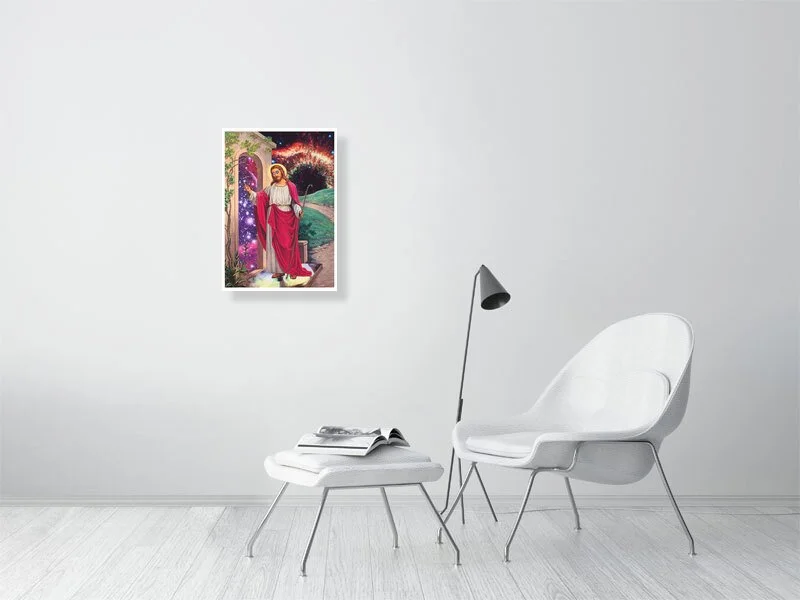
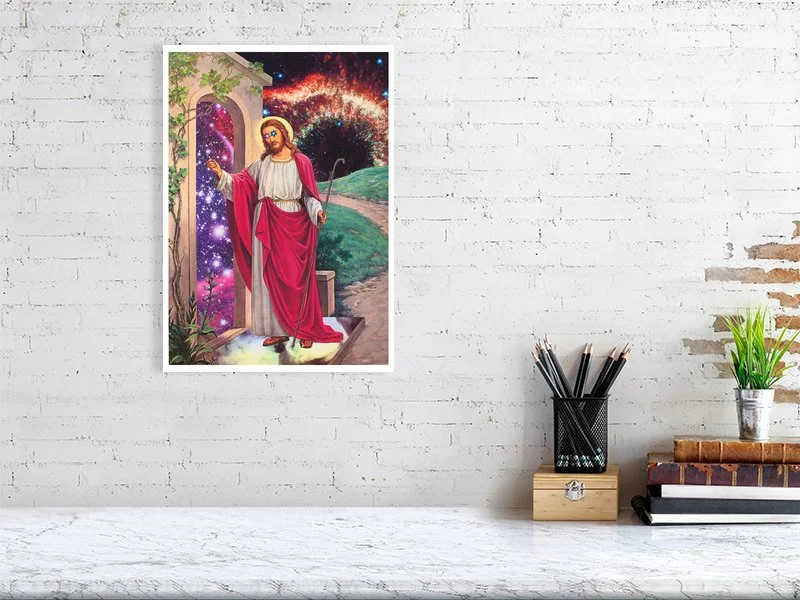
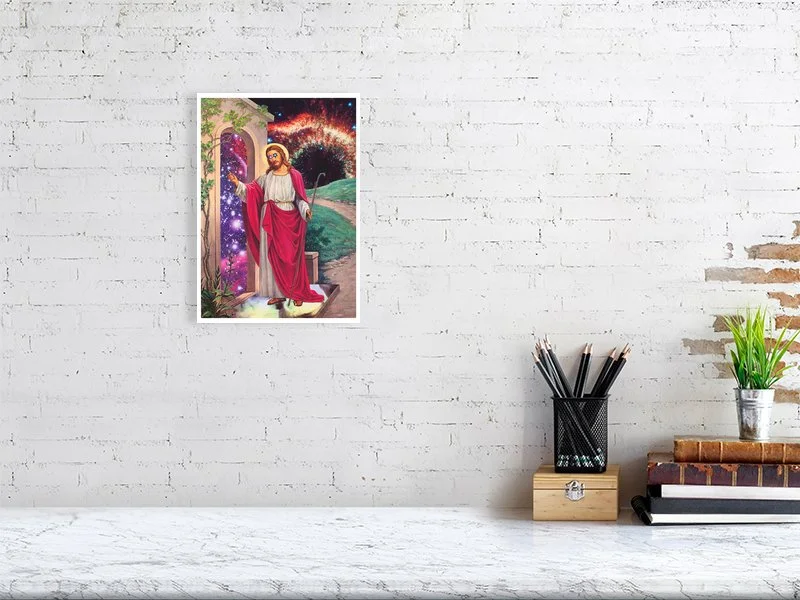
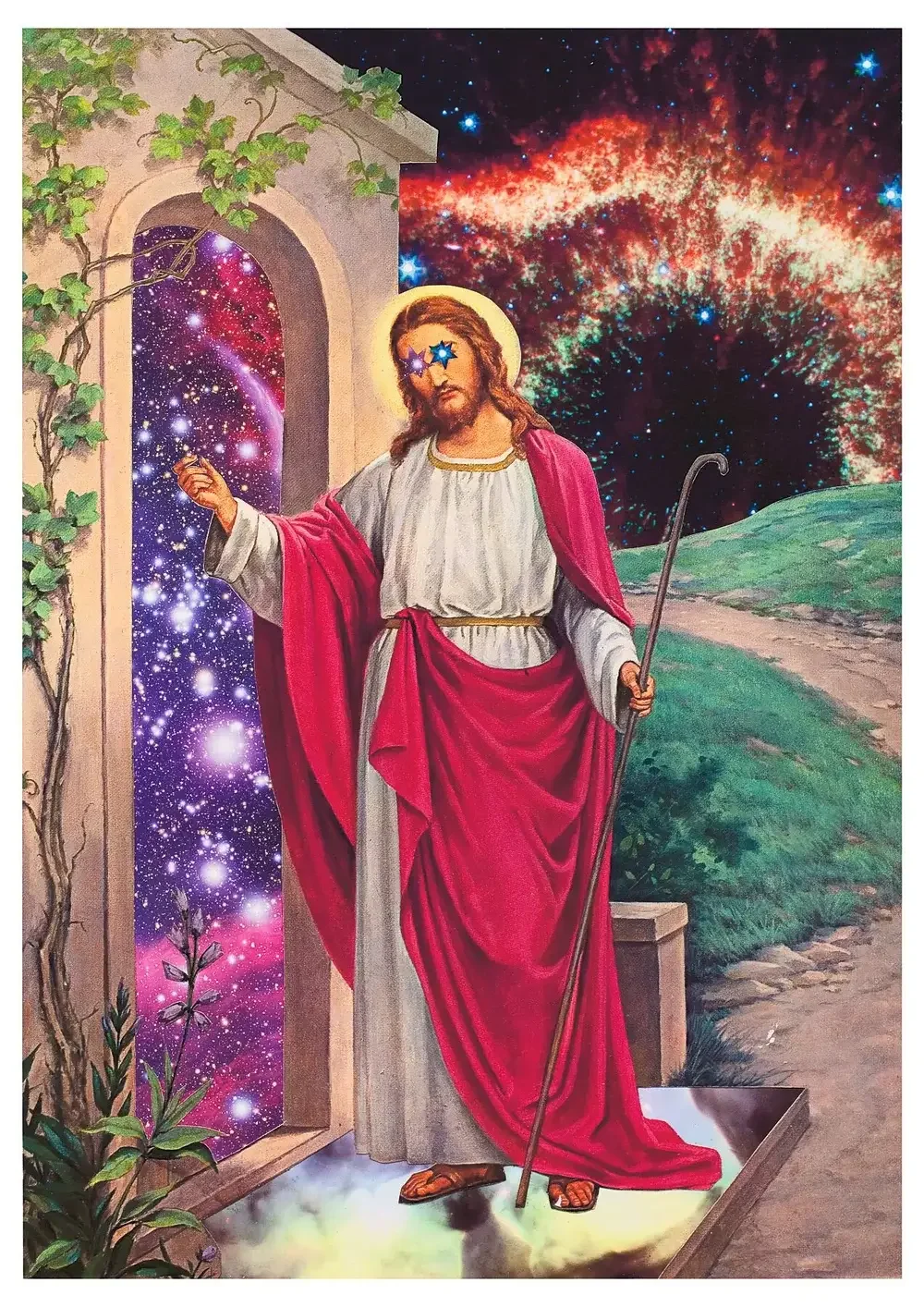
Jesus Christ knocking on heaven's door, beyond which there is the entire cosmos, lit up in stark colors and explosions. This Psychedelic Christian Art Print reproduces an original hand-cut paper collage by the artist Aleksandra Mir.
The new artwork combines source materials from antique religious and modern scientific imagery into a new physical and fantastical reality. The juxtaposition raises questions about faith, vision, the universe, and interfaith symbolism. The psychedelic dimension defined by the colour palette — deep purples bleeding into hot pinks, the electric nebula, the jewel-bright star — belongs as much to the visual language of 1960s and 70s psychedelic art as to astronomy.
The cosmos here does not feel cold and scientific but hallucinatory and visionary, as though the door Christ opens leads not simply to space but to an altered state of consciousness. The tradition of psychedelia was itself deeply spiritual — seeking transcendence through expanded perception — making the connection to religious iconography entirely natural.
Christ becomes a figure standing at the boundary between all belief systems and the infinite, his sight literally replaced by a symbol of another faith — he sees, and is seen, through multiple spiritual lenses simultaneously. The work sits at the precise intersection of three countercultural moments that each promised transformation: organised religion, the space age, and psychedelia — all three sharing the same fundamental hunger for transcendence beyond ordinary human experience.
Giclée pigment ink on Hahnemühle German Etching paper results in a superior quality print with exceptional detail, vibrant color accuracy, and long-term durability. The fresh print reproduces an aged authentic patina and the imprint of the artist’s hand-crafted marks.
· Archival Museum Quality ·
· Limited Edition. 100 ·
· Certificate of Authenticity ·
· Hand & Human-Made without AI ·
· 100% Carbon Neutral ·
· Free Worldwide Shipping ·
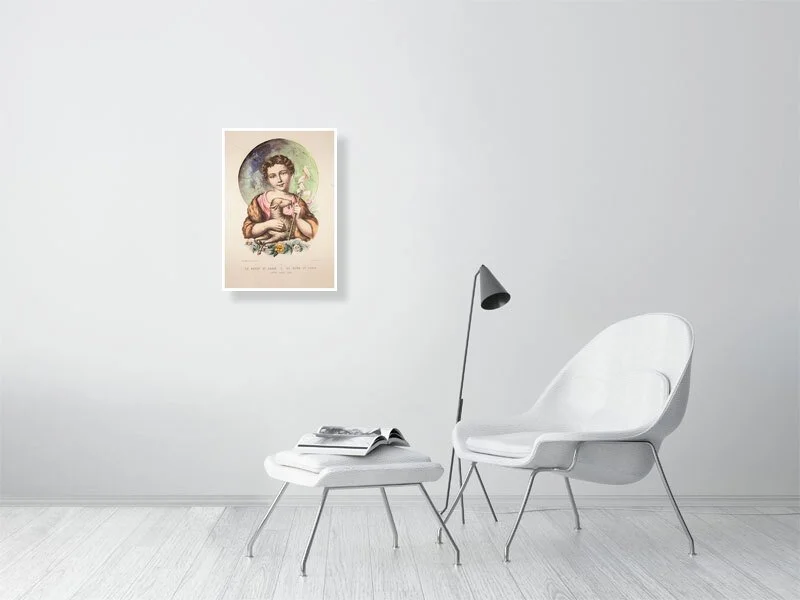
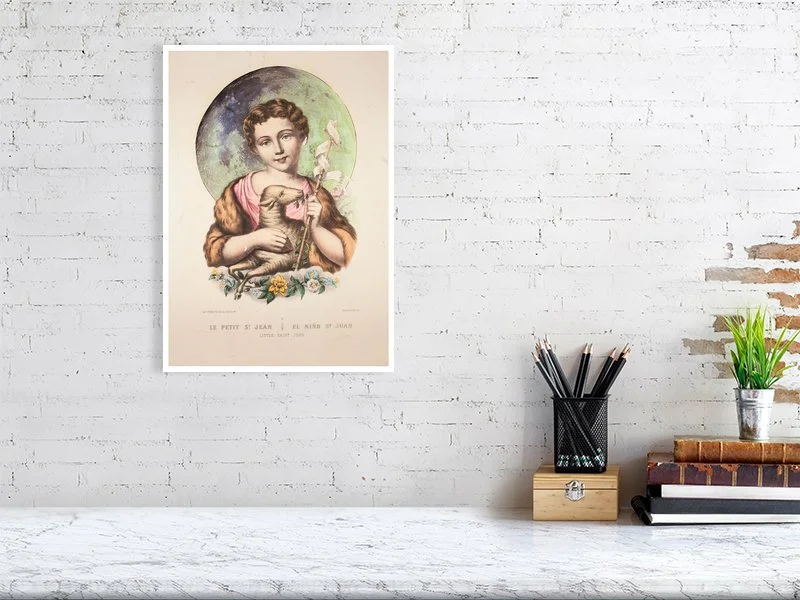
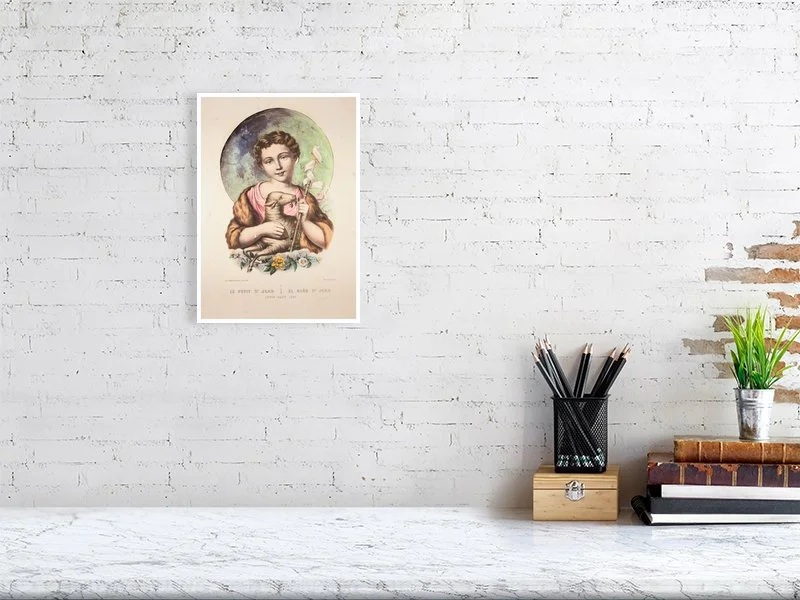
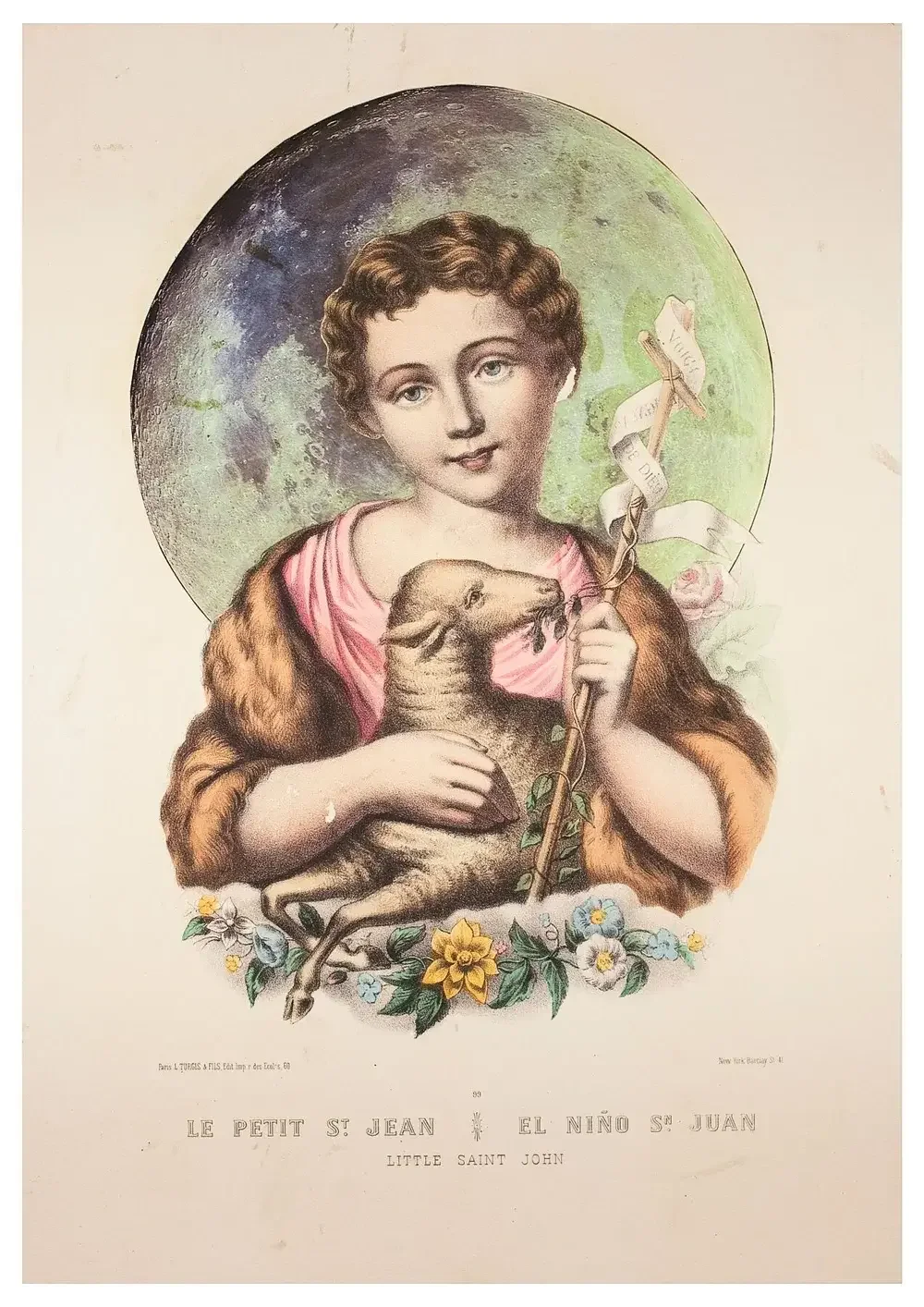
The young Saint John the Baptist is depicted holding a lamb and a cross-topped staff with a scroll, wreathed in flowers at the base. The circular halo behind his head has been replaced with a close-up photographic image of the Moon, its craters and maria visible in greens and purples. It's almost seamless, as if the moon is his halo. This charming Fine Art Print reproduces an original paper collage by the artist Aleksandra Mir.
The new artwork combines source materials from antique religious and modern scientific imagery into a new physical and fantastical reality. The divine light behind the saint becomes the actual lunar surface. Sacred radiance becomes scientific fact.
Giclée pigment ink on Hahnemühle German Etching paper results in a superior quality print with exceptional detail, vibrant color accuracy, and long-term durability. The fresh print reproduces an aged authentic patina and the imprint of the artist’s hand-crafted marks.
· Archival Museum Quality ·
· Limited Edition. 100 ·
· Certificate of Authenticity ·
· Hand & Human-Made without AI ·
· 100% Carbon Neutral ·
· Free Worldwide Shipping ·
Frequently Asked Questions
-
Aleksandra Prints are museum-quality reproductions of original hand-cut antique paper collages by artist Aleksandra Mir, created in her Palermo, Sicily studio in 2007–2009 and exhibited internationally for two decades.
Aleksandra Prints started on the initiative of an audience member who discovered the original artworks in an exhibition and asked for affordable reproductions.
What is a collage?
A collage combines elements from different sources into a new image and physical reality.
The materials for these collages were sourced from antique dealers and second-hand bookshops. As such, the fresh print reproduces a patina with authentic wear and tear.
Furthermore, in creating the collages, the artist sliced and tore through the source materials leaving the imprint of her hand-crafted marks.100% human-made. No AI was used in the creation of these artworks.
-
Giclée print on Hahnemühle German Etching paper
Giclée (pronounced "g-clay") comes from the French gicler — "to spray." The process uses high-resolution inkjet printing, pigment-based inks and acid free papers to deliver a superior quality print with exceptional detail, vibrant colour accuracy, and lasting durability.
Hahnemühle German Etching is a traditional mould-made copperplate paper. Crafted from 100% alpha cellulose, it has a distinctively velvety feel and fine felt texture that brings images to life with a striking three-dimensional depth. Acid- and lignin-free, it meets the highest standards of age resistance.
-
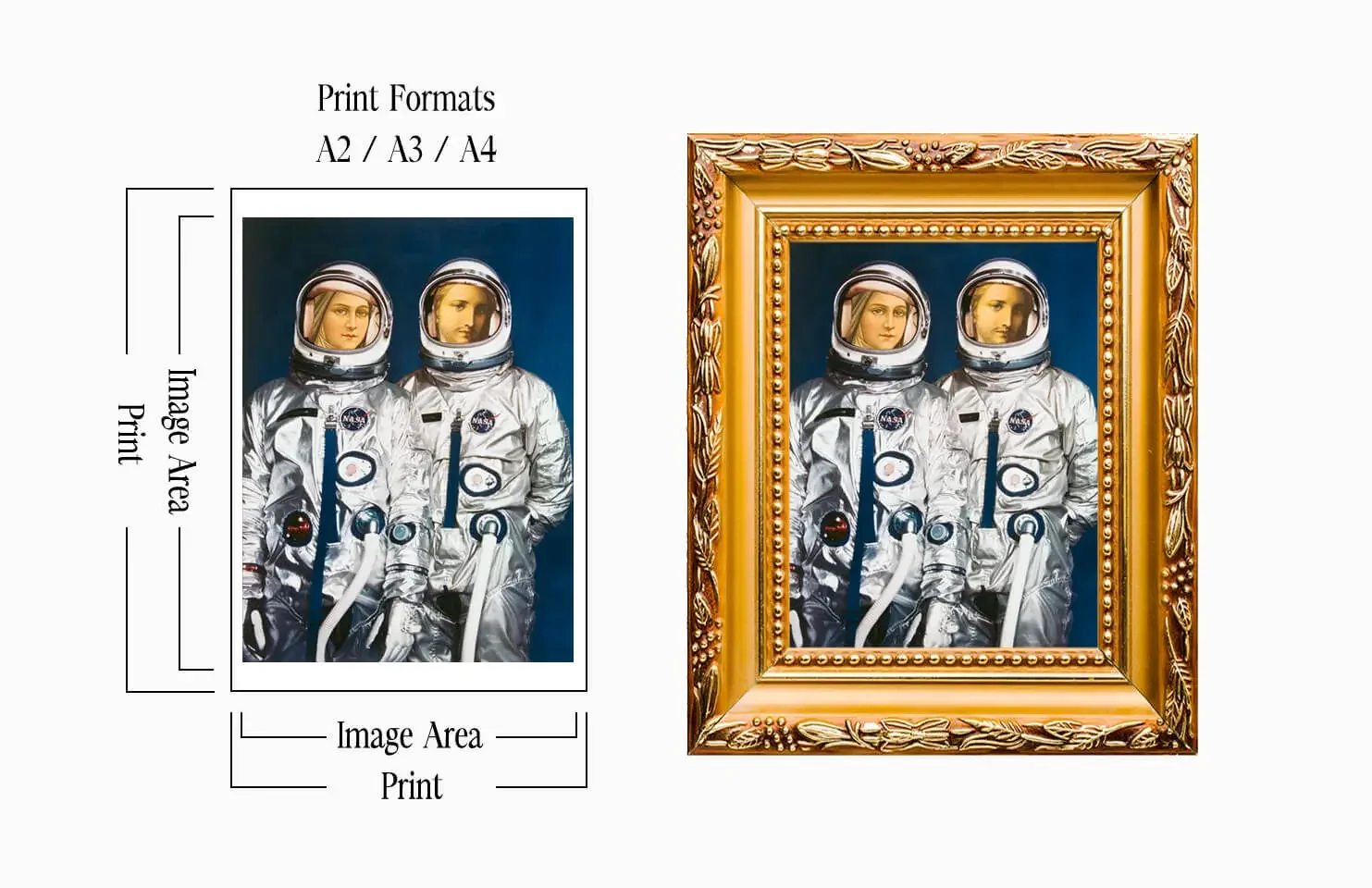
Aleksandra Prints come in three standard formats, Small, Medium and Large:
A4 (S) – 21 x 30cm / 8.3 x 11.7"
A3 (M) – 30 x 42cm / 11.7 x 16.5"
A2 (L) – 42 x 59cm / 16.5 x 23.4"Please note that each original collage was created in a unique format and the image areas within the prints therefore slightly vary. The image areas are surrounded by white space to create the uniform print formats: A2, A3 or A4.
You can keep the white space, extend it with a mat or crop it out when framing.
-
Aleksandra Prints are only available from this website, www.aleksandraprints.com
Each print comes with a signed and numbered Certificate of Authenticity that holds a 3D embossing.
We are able to confirm the first sale provenance of every print.
-
Aleksandra Prints does not offer framing because shipping artwork behind glass is both risky and expensive. It is much better to have your print framed closer to home.
We recommend these three style options:
Minimalist – A ‘frameless’ clip frame in glass or acrylic in standard A4, A3 or A2 formats that match the prints sizes exactly. These type of frames are easily available in shops and can be ordered online.
Mediumalist – Adding a larger white or colored mat to extend the white space around the image area up to any preferred size. This framing method protects the print by allowing some air between print and glass. Select any custom-sized frame and profile from a framer of your choice.
Maximalist - New or antique Gold, Bronze or Silver custom made frames with a different profile for each print. Visit a local framer to explore their profiles or source frames from markets and antique shops.
-
Aleksandra Prints offers FREE shipping worldwide.
Our prints are produced in and shipped from the United Kingdom by Royal Mail.
Production & Delivery:
(UK) 7 days
(EU/USA) 14 days
(Rest of the World) Pending Location.
Tracking: All orders are dispatched within 48 hours. As soon as a print is shipped you will receive an email with tracking details for your order.Customs Fees & Taxes:
UK orders: No VAT.
USA orders: No sales tax or tariffs.EU orders may be subject to local import VAT and a small customs handling fee payable on delivery. These charges are set by your country’s customs/courier and are not collected by us. The commodity code 4911 91 00 refers to pictures under the category of printed matter with a charge that can vary between ~7–27% of the order value. Please refer to your local customs office for the exact rate.
Some countries — including Brazil, Argentina, Indonesia, South Africa, Chile, Mexico, and others — may charge import duties, VAT, or customs clearance fees. These are not included in your payment and must be paid by the recipient upon delivery.
Contact us
Here to help and to answer your questions! -
Return Policy
All sales are final. Each print is made to order and numbered exclusively for you, so we are unable to accept returns. But if anything arrives damaged, we will make it right.We offer replacement prints if the product arrives damaged or is significantly delayed (postage delays which could be considered normal, or delays due to items being held up in customs will not be refunded).
Significant Delays
Although most orders arrive without any issue, some can be delayed. We will do our best to help find out what the issue is, but only after these times have passed can we make a claim with Royal Mail for loss and offer a replacement:
UK: 10 days
Europe: 25 days
Rest of the World: 32 daysDamaged prints
In the unlikely event the print arrives to you damaged, we will send a replacement free of charge. To arrange this please contact us within max 2 days with photos of the damaged print and its packaging.
We value your custom and thank you for your understanding and cooperation!
-
Aleksandra Prints are produced in the UK by a small 100% carbon neutral print facility, which means they minimise energy usage, use renewables, and offset the remaining emissions by investing in renewable energy projects.
Our paper manufacturer only use resources from sustainable forest management areas. This programme ensures the preservation and protection of biodiversity, the renewal of the forests habitats and decreasing of the impacts of exploitation of forest areas for future generations.
All the packaging used for our customer orders are a mixture of sustainably sourced, recyclable or biodegradable materials.