
Conceptual Collision
Reflections on the soul among the astronauts
I’m Karli Brittz, a scholar and lecturer whose work sits somewhere between visual culture, digital media, and the bigger philosophical questions about what it means to be human in a world increasingly shaped by technology. I currently lecture in New Media and Digital Culture at the University of Amsterdam, and before that I completed my PhD and a postdoctoral fellowship at the University of Pretoria in South Africa.
My research has taken me through a lot of different terrain but there's always been a thread running through it all. I'm drawn to the moments where the digital world bumps up against something deeply, stubbornly human. Something that resists being reduced to data or code or physical matter. In this case? The soul. Which is exactly why I found Aleksandra Mir’s collages so enchanting.
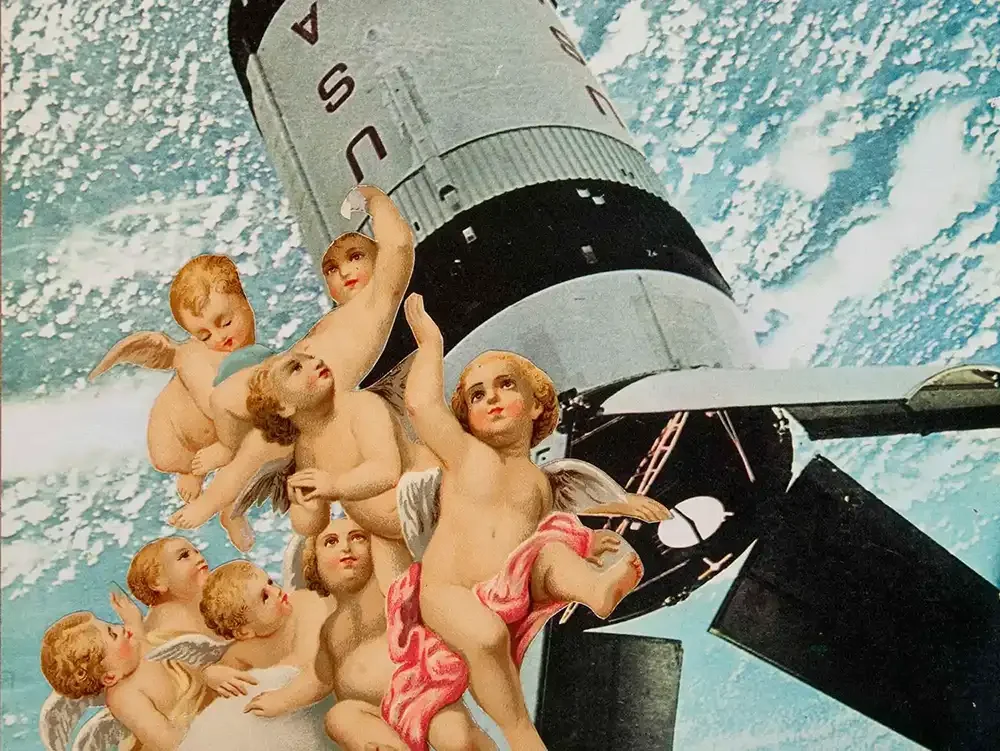
Aleksandra Mir, Dream and Promise (Detail)
Art, Astronauts, Angels
The first time I came across Aleksandra Mir's collages, I was deep in the research phase for an article trying to answer a question that had been nagging at me for a while: does the soul still have a place in our conversations about technology? I was trawling through visual examples that sat at the intersection of the spiritual and the digital, and then I landed on Mir's work. A religious icon looking up at a satellite, astronauts framed by halos, cherubs on a rocket launching ramp … I was instantly transfixed.
Each piece seemed to insist that the realm of the spiritual and the world of the technological, were connected in an important ongoing conversation.
There was something about the simplicity of the collage technique that made the conceptual collision feel all the more powerful. The artworks weren’t subtle, but they were also not heavy-handed. They were just pointing at something and saying: look, these two things are more alike than you think.
And so I followed the thread. I spent time moving through Mir’s exhibitions with a growing sense that I had found the right artist for the question I was trying to answer. Although there was plenty to choose from, the space travel collages kept drawing me back in. Each piece seemed to insist that the realm of the spiritual and the world of the technological, were connected in an important ongoing conversation. Perhaps, we humans had just stopped listening.
My argument was that exploring the soul in relation to technology actually reveals things about contemporary human experience that nothing else quite captures.
Searching for the soul
The piece I wrote was published in Image & Text in 2018, under the title Soul Searching: Finding Space for the Soul in the New Digital Age. The central argument was fairly straightforward, even if the terrain was somewhat theoretical. The soul tends to get left out of philosophical conversations about technology. It gets dismissed as too religious, too western, too outdated for a world governed by algorithms and I wanted to push back on that.
My argument was that exploring the soul in relation to technology actually reveals things about contemporary human experience that nothing else quite captures. It forces us to ask the kinds of questions that pure technoscience tends to sidestep: What is lost when we treat people as data points? What does it mean to form a meaningful relationship with a non-human entity? Can technology carry something like a soul? And what happens when we stop asking these questions altogether?
To make the argument, I turned to visual culture, specifically three examples that I felt were doing genuinely interesting philosophical work: Spike Jonze's film her (2013), Mike Nichols's television film Wit (2001), and the collage work of Aleksandra Mir. Each of these examples, I argued, opens up a different kind of space for thinking about the soul in the digital age. Her explores the possibility of an animistically ensouled technology - what if our operating systems developed something like consciousness, desire, and emotion? Wit takes the opposite angle, presenting a world from which the soul has been deliberately excluded in favour of physicalist, technoscientific thinking, and showing us the human cost of that exclusion. And Mir's work sits between these two poles, fusing the spiritual and the technological in a way that feels less like a crash and more like an entwinement.
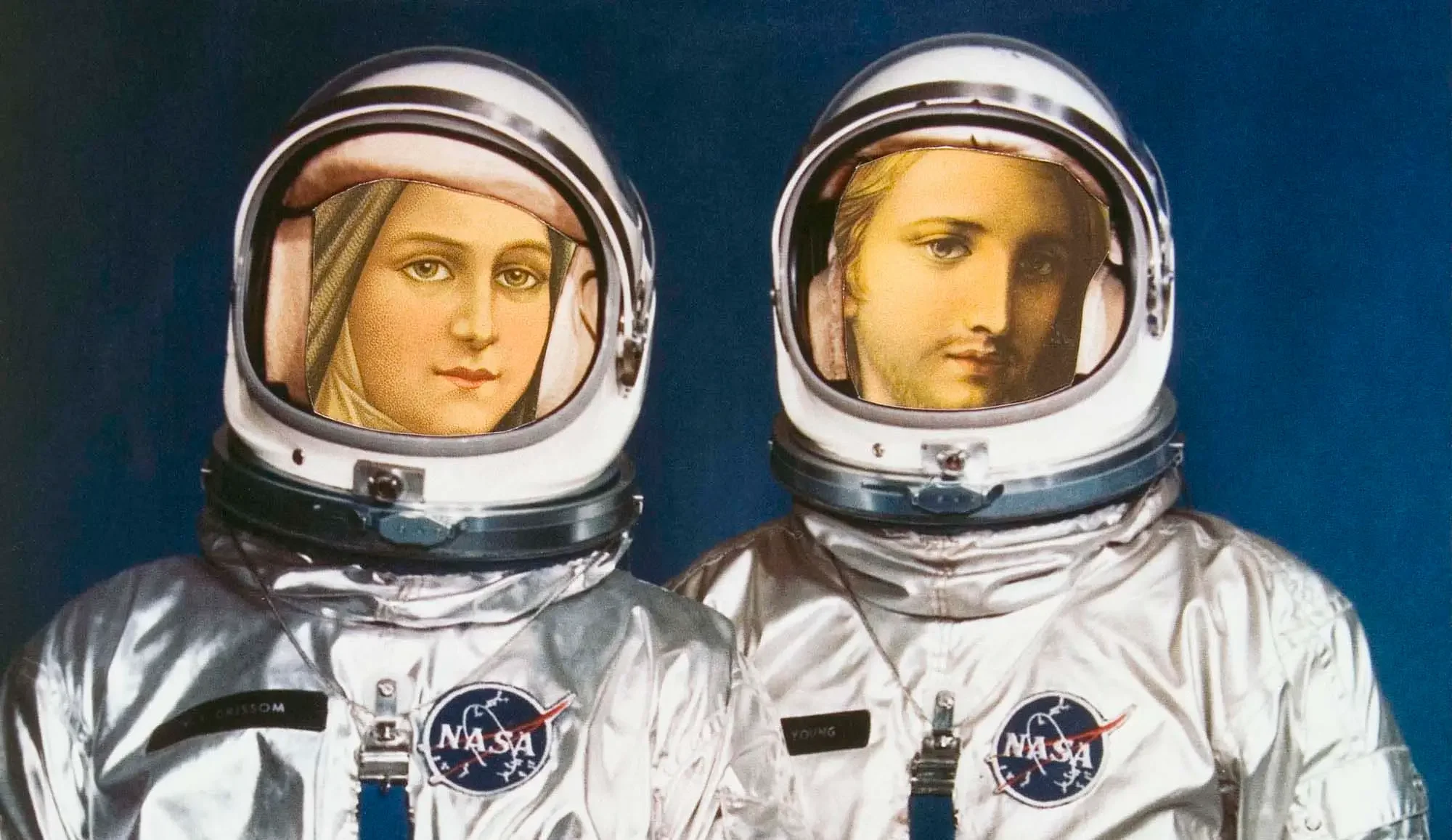
Aleksandra Mir, American Gothic (Detail)
What makes the collages so effective is that they don’t take themselves too seriously. They are witty and playful and we can enjoy the absurdity in their juxtaposing images.
The cosmic collages
Mir's work across series like The Dream and The Promise merge images of space travel with imagery drawn from religious and spiritual traditions. We are transported into a world where rockets exist alongside Renaissance saints, astronauts have halos and Saints look up at satellites.
What I found compelling about this work, and what I argued in the article, is that it illuminates a dualistic perspective on the soul: one that sees a possibility of transcending Earth, while imagining technology as a possible vehicle for that transcendence. The astronaut becomes a figure of posthumanism: a human body that has merged with technology in order to escape the limitations of the earth, quite literally breaking free of gravity. When you place that figure alongside angels or celestial beings freed from earthly constraint, the parallel becomes almost uncomfortably clear.
Typically, space travel and spirituality are positioned as opposing forces, when in fact there is considerable evidence that the two converge. To me, these collages make that convergence visible. We are taken into a world where the circular halo of a saint becomes the glass dome of an astronaut's helmet and angels gather around a space shuttle. These aren't superficial visual puns - they're pointing at something interesting about the spiritual dimensions of our technological ambitions.
To help understand this convergence further I also drew on the philosopher Michel Serres, who argues that technology itself shows angelic characteristics. In other words, aircrafts, telephones, and electronic signals are all, in a sense, messengers or postmodern angels transmitting meaning across space. Mir’s work gives Serres’s idea an interesting visual form.
What makes the collages so effective is that they don’t take themselves too seriously. They are witty and playful and we can enjoy the absurdity in their juxtaposing images. The lightness is part of what makes the deeper argument land. You smile first, then you recognise and then you are able to contemplate.
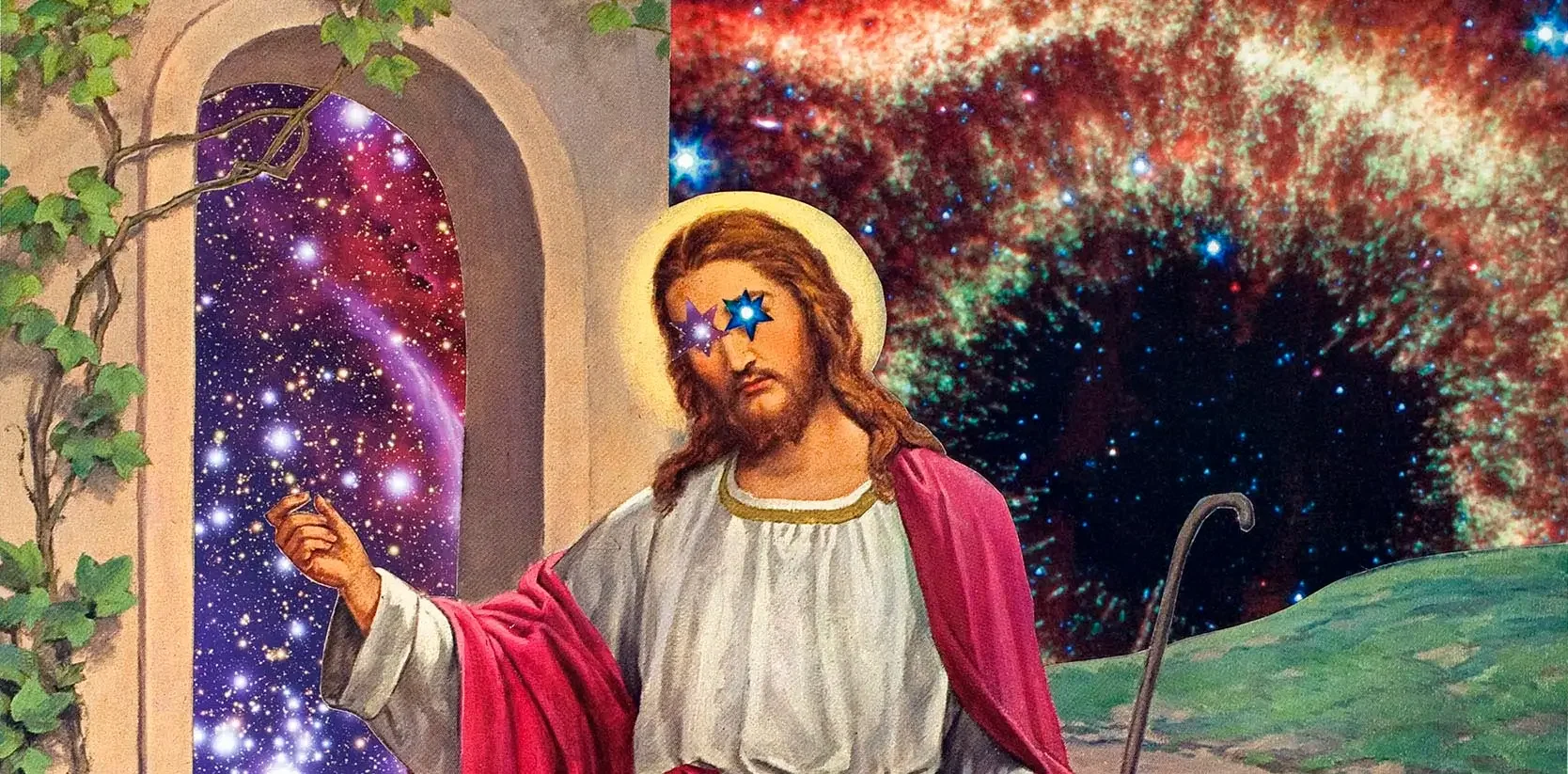
Aleksandra Mir, At the Door (Detail)
Mir's work balances and brings together two different components of life…the world of space and symbols of the transcending soul collide.
Excerpt from my piece Soul Searching: Finding Space for the Soul in the New Digital Age, written in 2018
“This amalgamation of space travel and the spiritual soul, which occurs throughout Aleksandra Mir's work, emphasises important aspects of the journey of the soul, especially in terms of a dualistic and gnostic outlook on the soul. Perhaps the most prominent gnostic feature in the collages is the collision of two seemingly opposing realms. Following the gnostic train of thought, Mir's work balances and brings together two different components of life. For example, in The promise of space one of the 33 images places a typical religious image of Sunday school teaching, or then relatedly the image of Jesus teaching the disciples, on Mars, while another shows a folkloric religious icon playing piano on the moon. In both these images, the world of space and symbols of the transcending soul collide […]
Mir's artwork also incorporates angels and celestial beings. In The passion and Astronauts, for example, Mir relates the ideas of angels and astronauts arguing: 'if angels and astronauts share the same sky, isn't it time they were introduced?' In doing so Mir shows how certain aspects of space travel and the gnostic journey of the soul have correlating parallels. For example, Mir suggests that the circular halo of angels resembles the astronautic suit's head, as yesterday's halo becomes today's helmet […]
This highlights the ongoing debate of the posthuman future: does posthumanism have the potential to enhance and save the soul, or does it hold the threat of destruction and detachment of the soul? To a certain extent the notion of the astronaut, as it is presented in Mir’s work, argues that posthuman technology has the potential to aid the soul, since the space journey sets forth the soul’s spiritual journey. Accordingly, Mir’s artworks, as well as other similar visual culture depicting space travel such as Alfonso Cuarón’s Gravity (2013) or Ridley Scott’s The Martian (2015), opens up a space to consider posthuman technology in relation to a spiritual soul. Moreover, within this space where the spiritual soul exists amongst technology, technology is positioned as an aid and freeing mechanism to the soul, which, similar to her, also initiates further conversation and debate on the effects of technology on the soul.”
You can read the full article HERE
Returning to this passage today, I am struck by how much these questions still resonate. The article was written with academic intention and in an academic register, as it needed to be, but underneath it all is something simpler: a fascination with artworks that uses visual language to illustrate a larger search for meaning and the soul. And I think, for me, that is still why I find these prints so exciting.
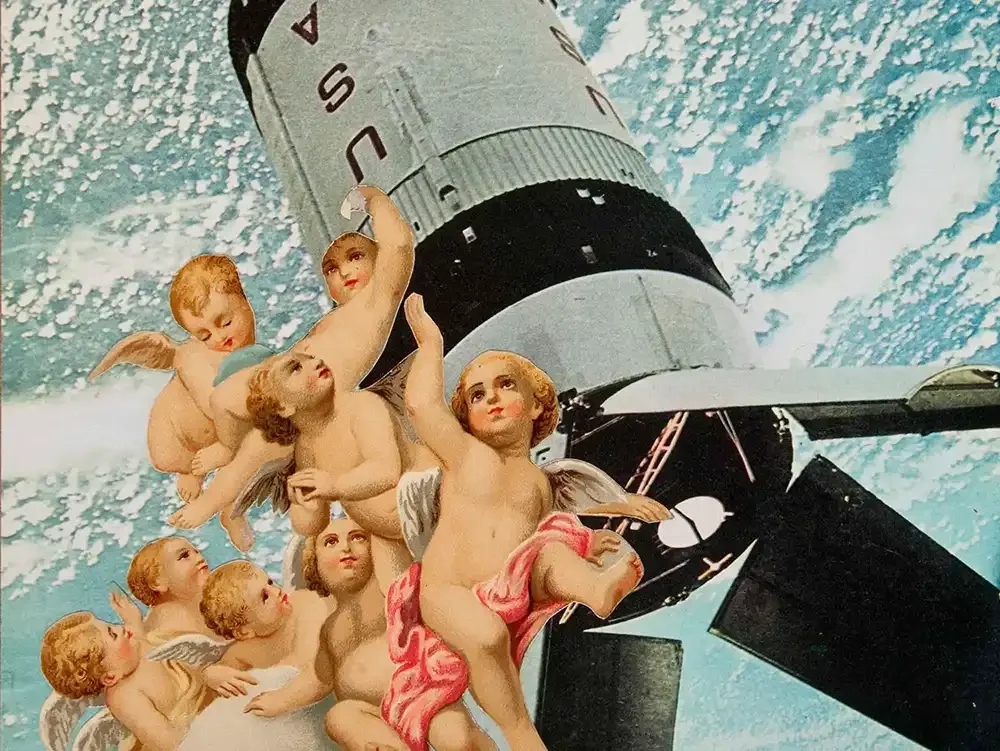
Aleksandra Mir, Astronaut (Detail)
In their own unique ways, the space programme and the cathedral are both responses to the same question: could there be something more?
The questions that do not go away
I wrote this article in 2018, but if anything, I think the questions it raises have become more urgent. We are now living through a period in which the boundaries between human and machine are being renegotiated at a pace that is difficult to keep up with. Artificial intelligence is no longer just a science fiction premise, it has become our daily reality. We talk to AI assistants, form attachments to chatbots and debate whether large language models might have something like inner experience. The questions that her posed as a near-future thought experiment in 2013 now feel like present-tense reality.
And yet, in most of the mainstream (and scholarly) conversations about AI and technology, the soul is still notably absent. We talk about intelligence, about consciousness, about ethics, about bias, but we rarely talk about soul. We hardly ever wonder about AIs quality of presence, depth, and humanness that we instinctively reach for when we want something to truly matter.
Perhaps even more starkly, the same blind spot shows up in how we talk about space. We are living through a genuine second space age. SpaceX is launching satellites by the hundreds and NASA is sending missions to the Moon and beyond. Mars is no longer a fantasy but a stated destination, complete with timelines, engineers and billionaires willing to bet their legacies on getting there. The language around all of it is relentlessly rational: orbital mechanics, payload capacity, terraforming timelines, colonisation logistics. It is the vocabulary of mastery and problem-solving.
Yet the impulse underneath space travel that involves an ache to leave the earth and to solve the mysteries of what is out there, is not a rational one. I don’t think it ever has been. We have always looked up and we have always projected meaning onto the sky. The constellations we named, the heavens we populated with gods, the cathedrals we built pointing upward: these were all, in their own way, space programmes. But in our current conversation about rockets and red planets this spiritual dimension is largely missing. The soul, again, does not make the discourse.
Mir's work refuses that absence. Through the most direct visual means available, these artworks contend that the spiritual and the technological are not opposites. That our hunger for transcendence is perhaps the same hunger that has always animated religious thought. Here, the astronaut and the angel are reaching for the same thing. In their own unique ways, the space programme and the cathedral are both responses to the same very human question: could there be something more?
These collages act as an entry point into a much larger conversation that contemporary art and visual culture continue to open up. Not only in Mir’s prints, but across all kinds of media including film, television, fine art and beyond, there is a wider need to keep returning to the soul and transcendental thinking. It remains an ongoing and urgent discussion to help us make sense of the role that technology plays in our lives. Art and visual culture have a particular ability to hold space for both science and soul, reminding us of the importance of being human amongst algorithms and spaceships. The soul, as it turns out, is alive and well in the digital age and may be more necessary now than ever.
*
Collect Aleksandra Prints
Visit the Print Shop
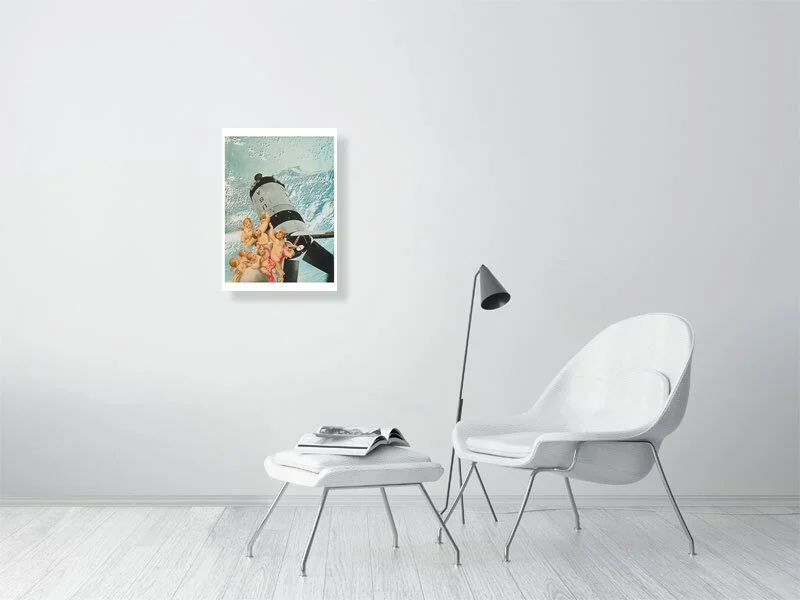
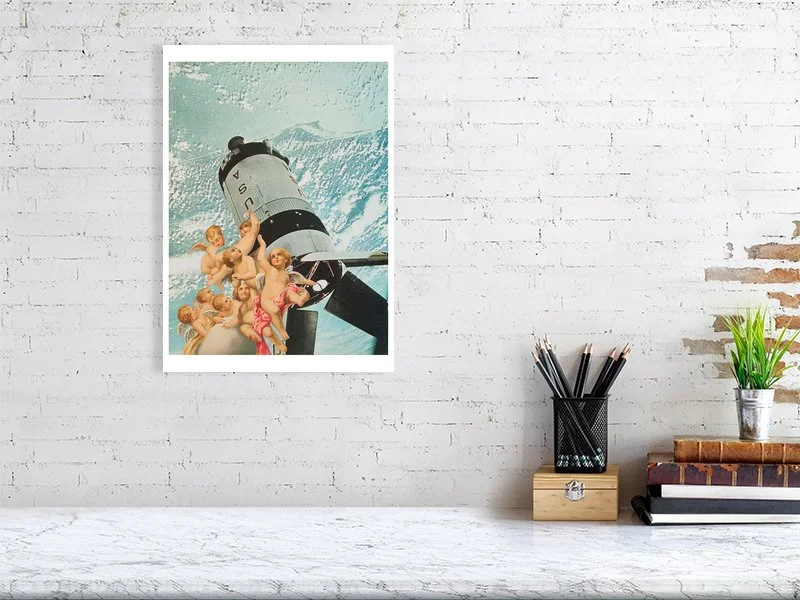
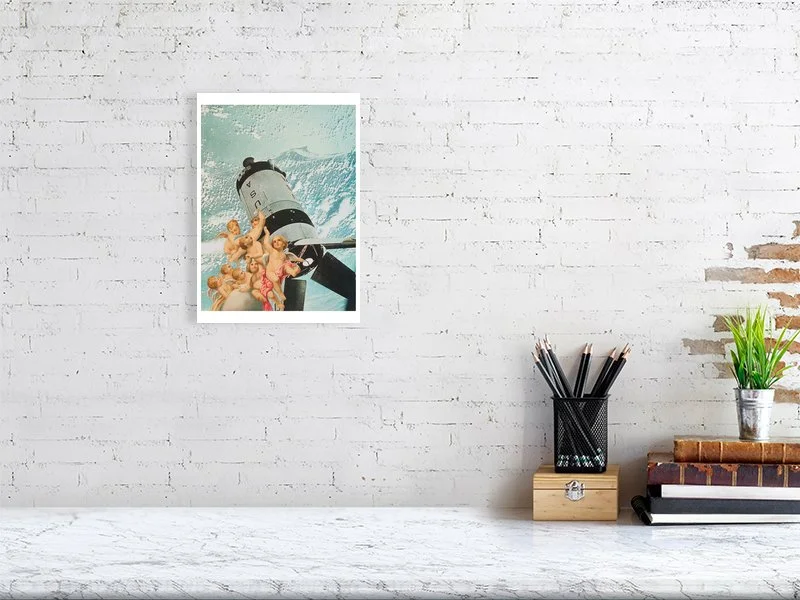
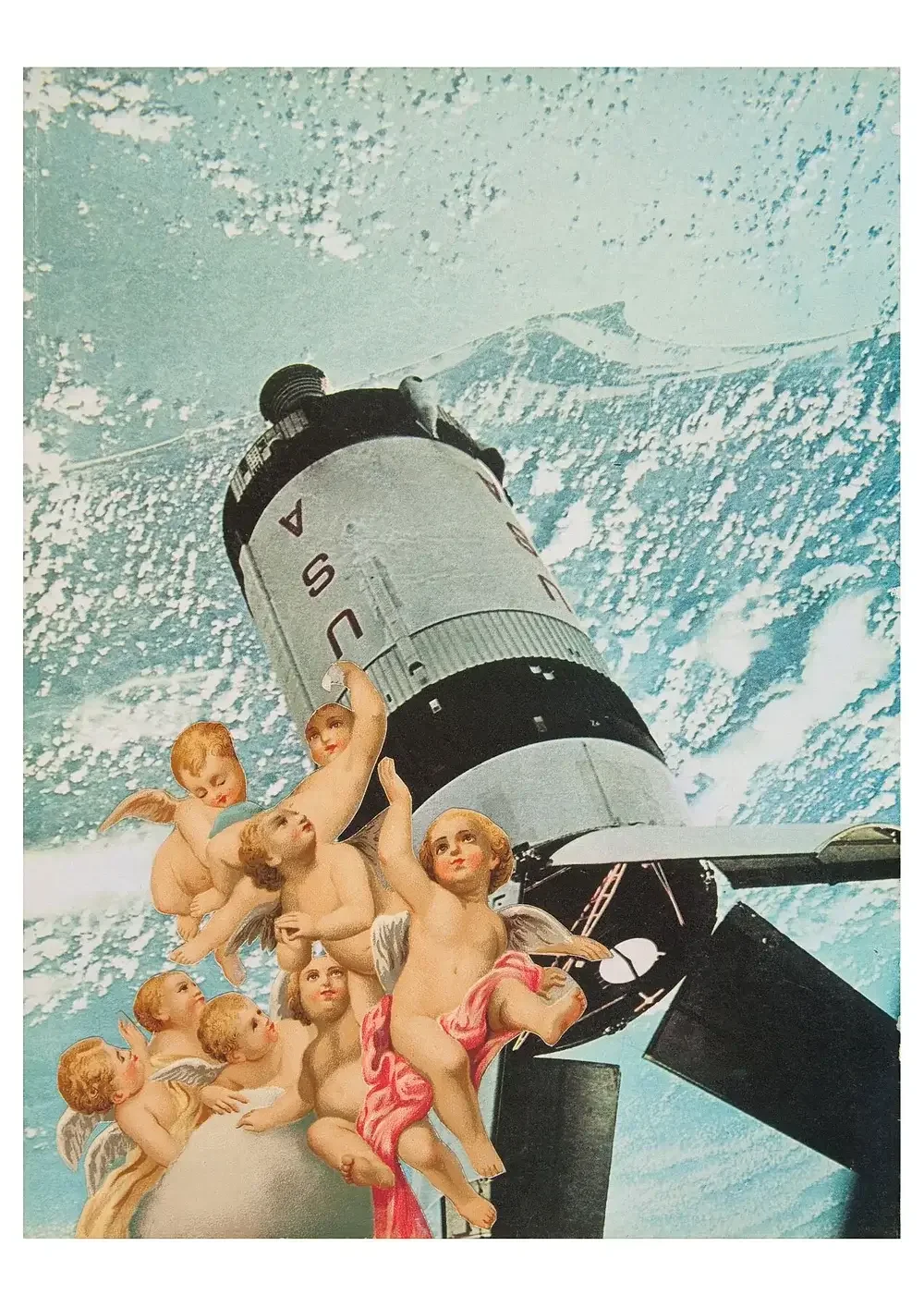
A cluster of cherubs — putti, the chubby winged angels drawn from Renaissance and Baroque painting — surround an outer space rocket. Together they are launched into the blue heavens or perhaps all the way to outer space. This joyful Fine Art Print reproduces an original hand-cut paper collage by the artist Aleksandra Mir.
The new artwork combines source materials from antique religious and modern scientific imagery into a new physical and fantastical reality.
The cherubs, traditionally symbols of the divine and heavenly aspiration, have transferred their devotion from the sacred to the technological. The rocket becomes the new object of veneration — humanity's collective dream made metal. The old world meets the new in an incongruous but tender embrace.
Giclée pigment ink on Hahnemühle German Etching paper achieves a superior quality print with exceptional detail, vibrant color accuracy, and long-term durability. The fresh print reproduces an aged authentic patina and the imprint of the artist’s hand-crafted marks.
· Archival Museum Quality ·
· Limited Edition. 100 ·
· Certificate of Authenticity ·
· Hand & Human-Made without AI ·
· 100% Carbon Neutral ·
· Free Worldwide Shipping ·
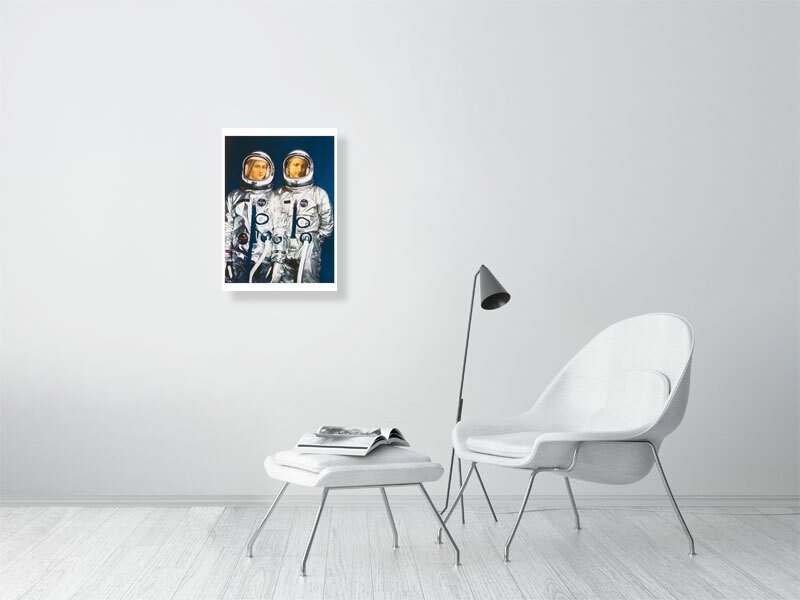
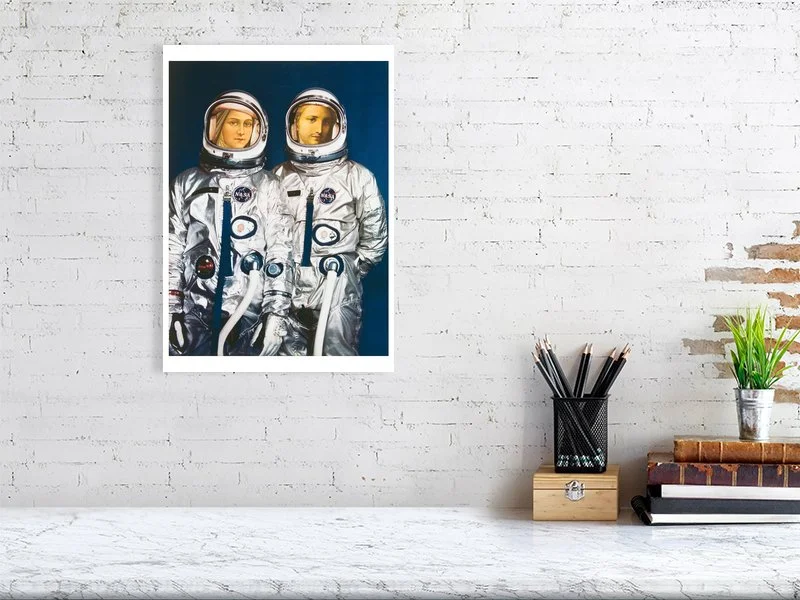
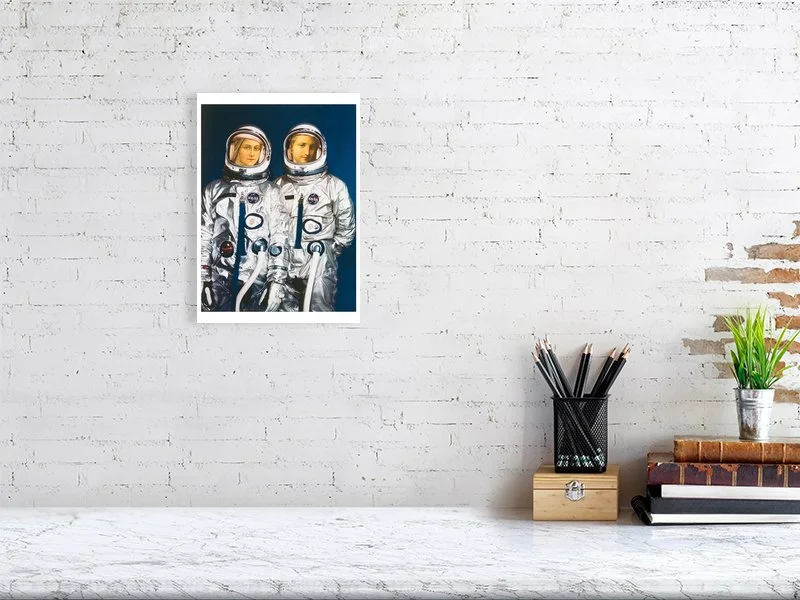
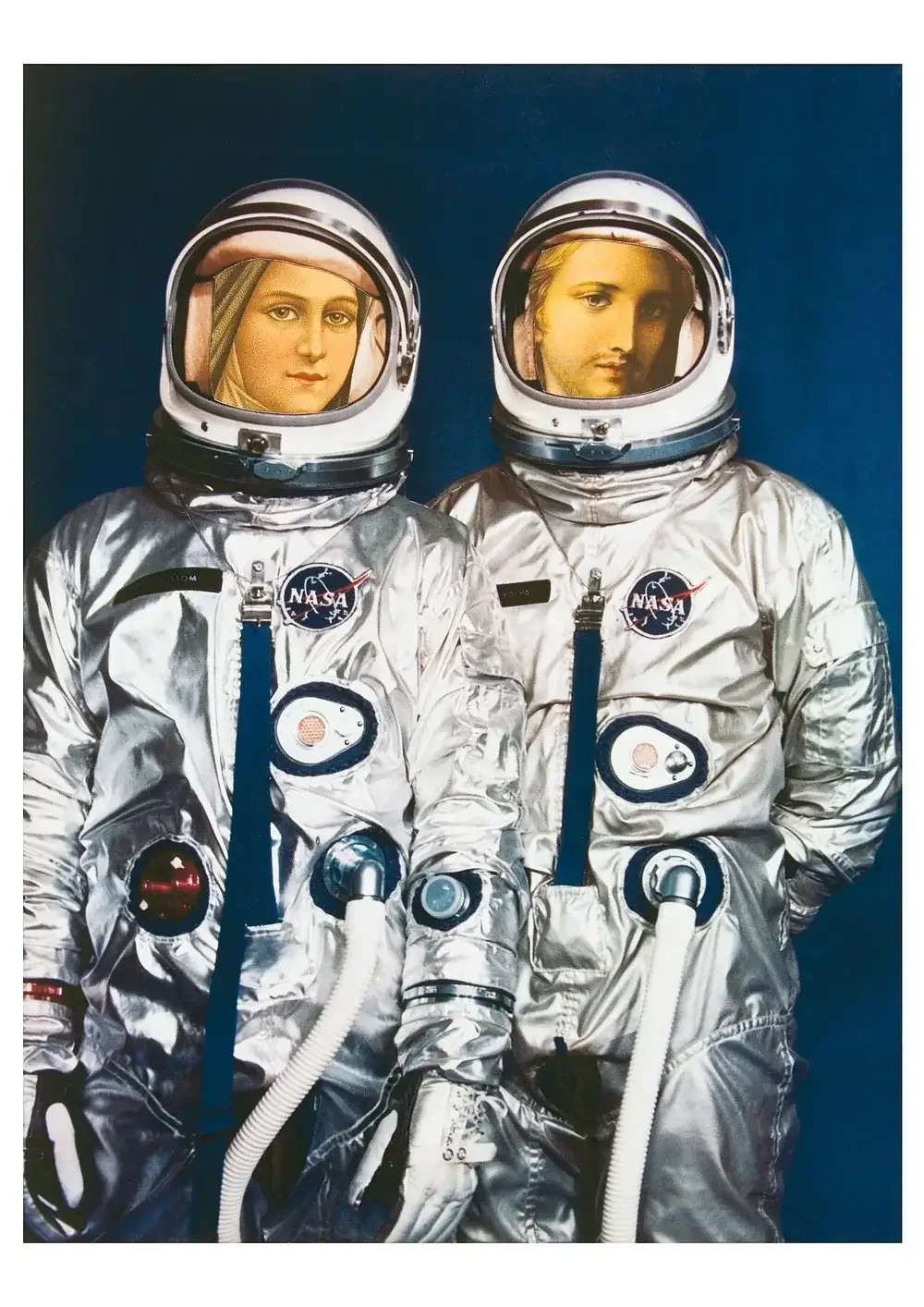
Two astronauts with the faces of Mary and Jesus Chris. This striking Fine Art Print reproduces an original hand-cut antique paper collage by the artist Aleksandra Mir.
The cleverly constructed collage and its title plays on Grant Wood's iconic 1930 painting American Gothic — but instead of a stern farmer and his wife standing before a Gothic-style house, we have two figures in gleaming silver NASA spacesuits from the early space age (Gemini-era, circa 1960s). Inside the helmet visors, replacing the astronauts' faces, are collaged Renaissance portraits from devotional religious paintings — The Madonna and Jesus Christ.
Aleksandra Mir has transported Wood’s original farm worker and his wife from rural America into the space race, and replaced their very identities with Old World sacred imagery. It's a witty commentary on American ambition, technology as a new religion, and the collision of the sacred and the scientific.
Giclée pigment ink on Hahnemühle German Etching paper results in a superior quality print with exceptional detail, vibrant color accuracy, and long-term durability. The fresh print reproduces an aged authentic patina and the imprint of the artist’s hand-crafted marks.
· Archival Museum Quality ·
· Limited Edition. 100 ·
· Certificate of Authenticity ·
· Hand & Human-Made without AI ·
· 100% Carbon Neutral ·
· Free Worldwide Shipping ·
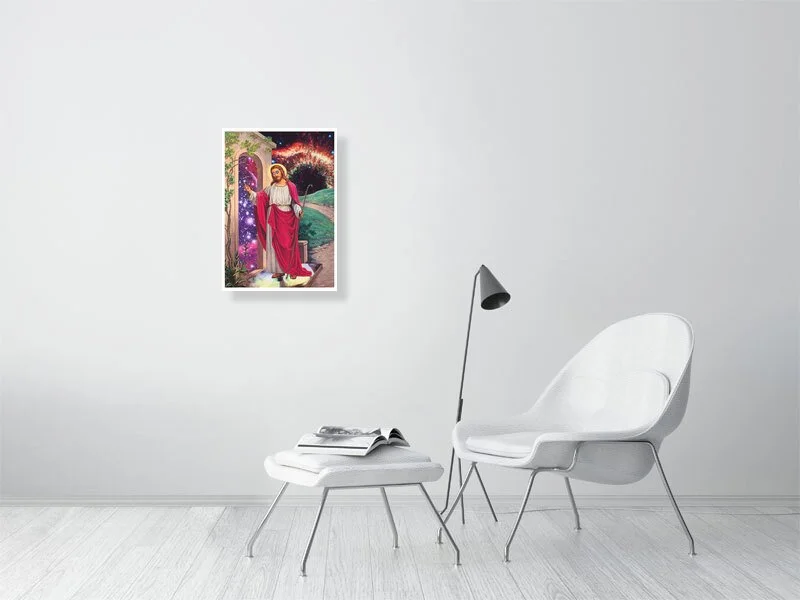
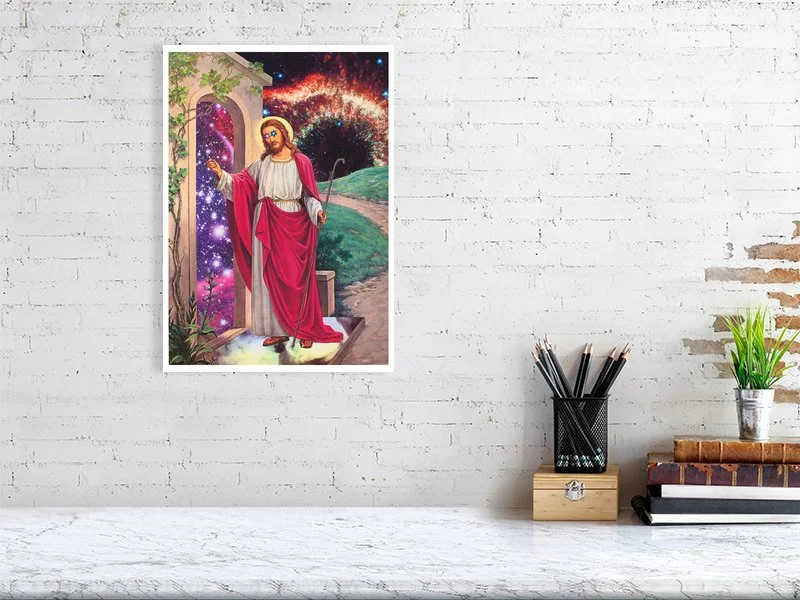
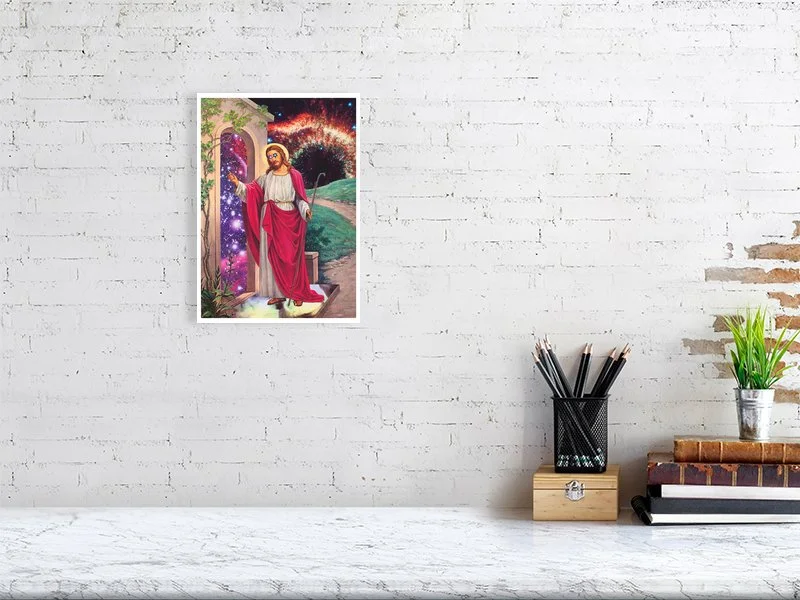
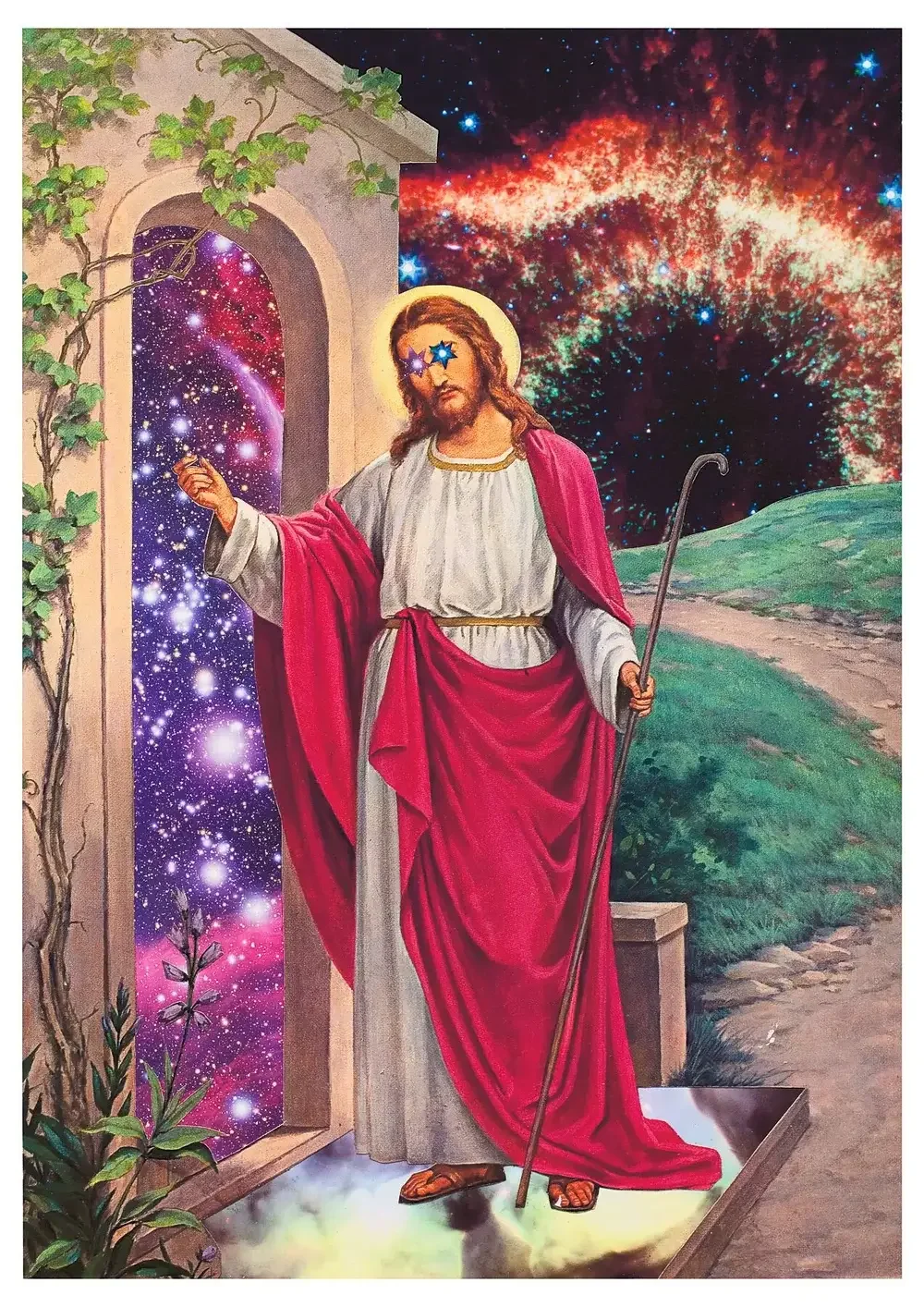
Jesus Christ knocking on heaven's door, beyond which there is the entire cosmos, lit up in stark colors and explosions. This Psychedelic Christian Art Print reproduces an original hand-cut paper collage by the artist Aleksandra Mir.
The new artwork combines source materials from antique religious and modern scientific imagery into a new physical and fantastical reality. The juxtaposition raises questions about faith, vision, the universe, and interfaith symbolism. The psychedelic dimension defined by the colour palette — deep purples bleeding into hot pinks, the electric nebula, the jewel-bright star — belongs as much to the visual language of 1960s and 70s psychedelic art as to astronomy.
The cosmos here does not feel cold and scientific but hallucinatory and visionary, as though the door Christ opens leads not simply to space but to an altered state of consciousness. The tradition of psychedelia was itself deeply spiritual — seeking transcendence through expanded perception — making the connection to religious iconography entirely natural.
Christ becomes a figure standing at the boundary between all belief systems and the infinite, his sight literally replaced by a symbol of another faith — he sees, and is seen, through multiple spiritual lenses simultaneously. The work sits at the precise intersection of three countercultural moments that each promised transformation: organised religion, the space age, and psychedelia — all three sharing the same fundamental hunger for transcendence beyond ordinary human experience.
Giclée pigment ink on Hahnemühle German Etching paper results in a superior quality print with exceptional detail, vibrant color accuracy, and long-term durability. The fresh print reproduces an aged authentic patina and the imprint of the artist’s hand-crafted marks.
· Archival Museum Quality ·
· Limited Edition. 100 ·
· Certificate of Authenticity ·
· Hand & Human-Made without AI ·
· 100% Carbon Neutral ·
· Free Worldwide Shipping ·
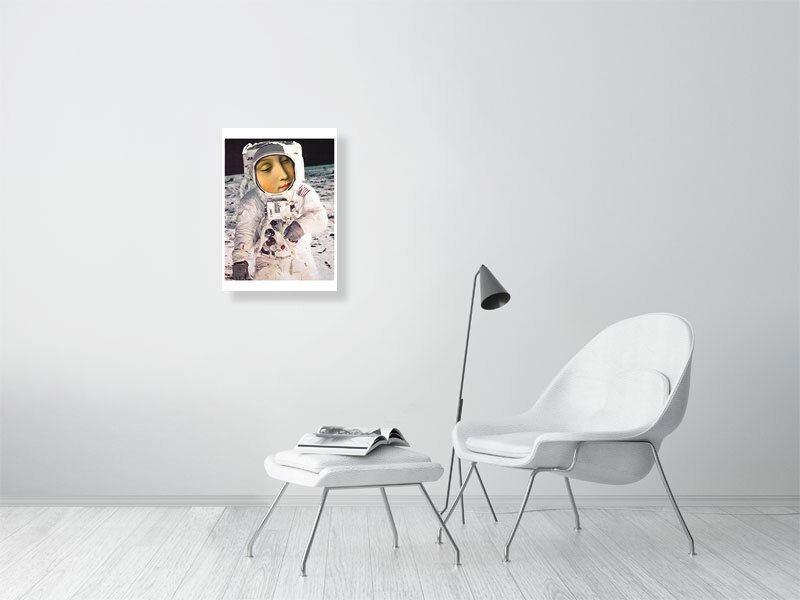
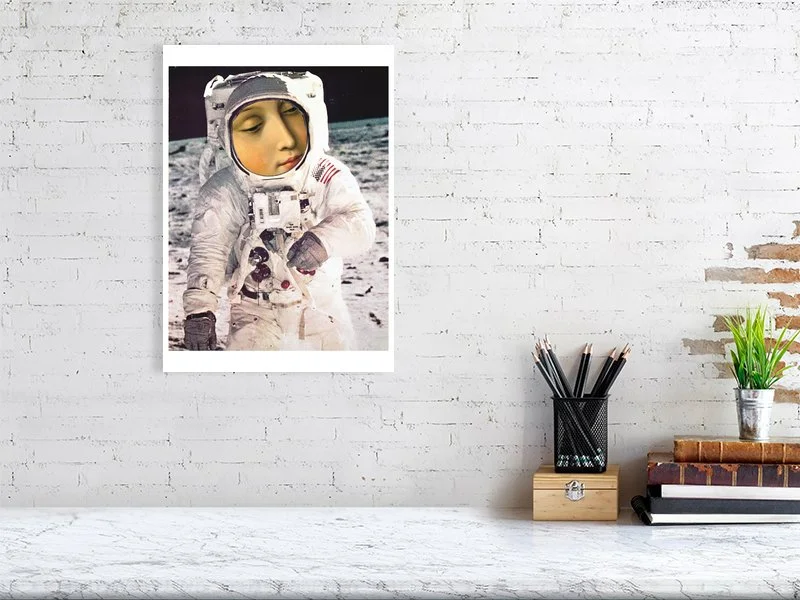

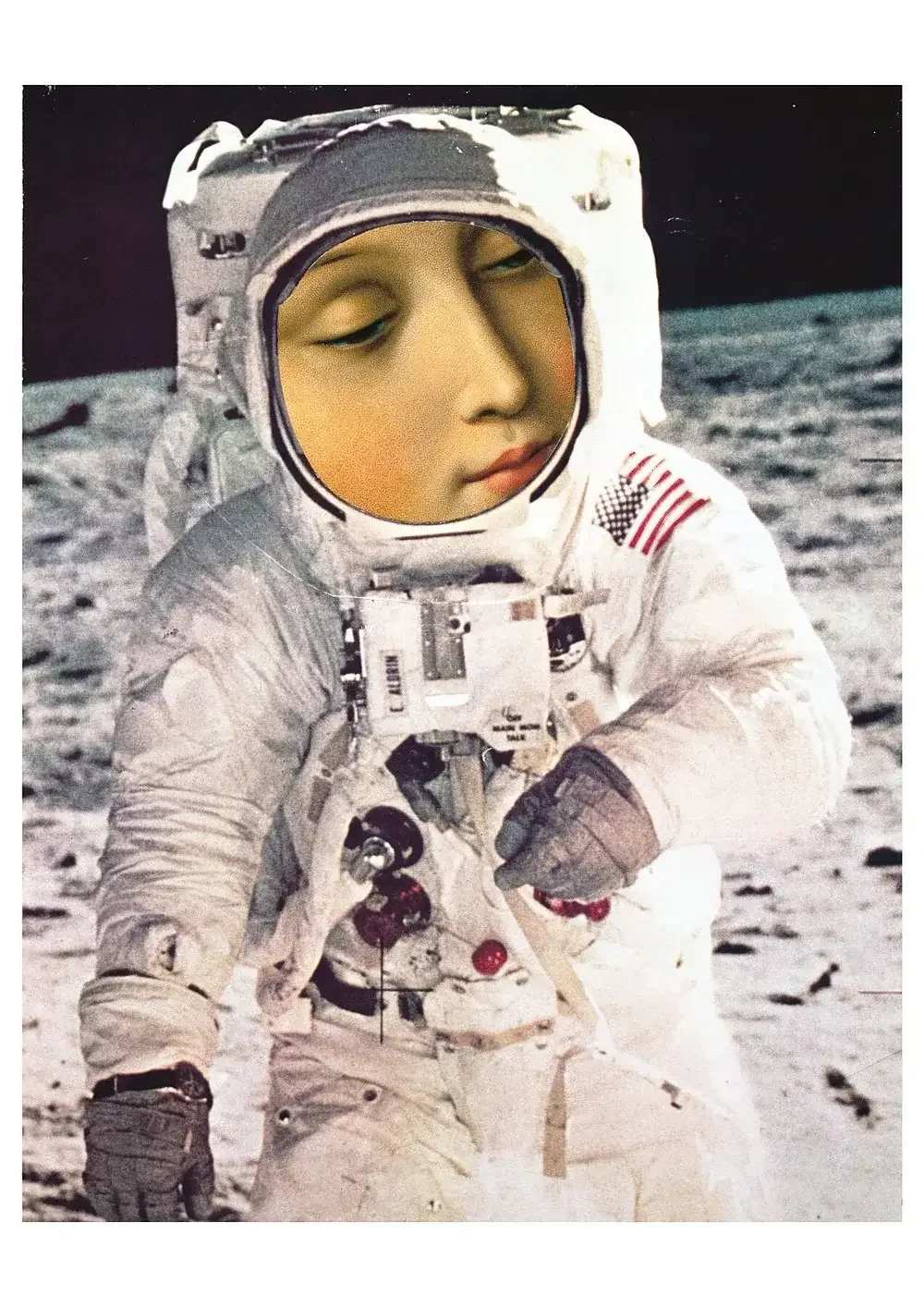
An astronaut with the face of a Saint has landed on the Moon. This is a Fine Art Print of an original hand-cut paper collage by Aleksandra Mir.
The new artwork combines source materials from antique religious and modern scientific imagery into a new physical and fantastical reality. The collage combines an iconic NASA Apollo-era photograph with a Renaissance-era painting. Both the Renaissance church and NASA's space programme represent the greatest collective ambitions of their respective ages — one reaching toward God, the other toward the cosmos. Both demanded total devotion, sacrifice, and the marshalling of the finest human minds and resources of their time. Both produced objects of transcendent beauty in the process. The saint and the astronaut are mirror images across five centuries.
By placing one inside the other, the work asks: have we simply replaced one form of devotion with another? Or were they always the same impulse — the human need to reach beyond the known world toward something greater than ourselves? The contrast between the technical, industrial spacesuit and the serene, almost meditative expression of the painterly saint’s face is quietly profound. It suggests innocence, wonder, or perhaps the inner life behind great human endeavour.
Giclée pigment ink on Hahnemühle German Etching paper achieves a superior quality print with exceptional detail, vibrant color accuracy, and long-term durability. The fresh print reproduces an aged authentic patina and the imprint of the artist’s hand-crafted marks.
· Archival Museum Quality ·
· Limited Edition. 100 ·
· Certificate of Authenticity ·
· Hand & Human-Made without AI ·
· 100% Carbon Neutral ·
· Free Worldwide Shipping ·